About Potamochoerus larvatus (F.Cuvier, 1822)
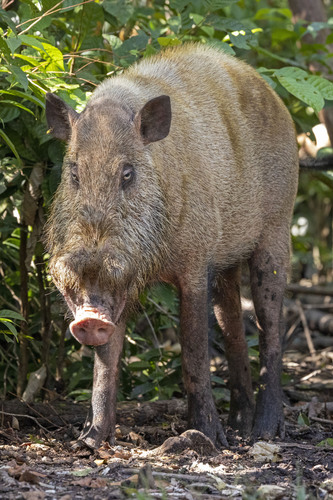
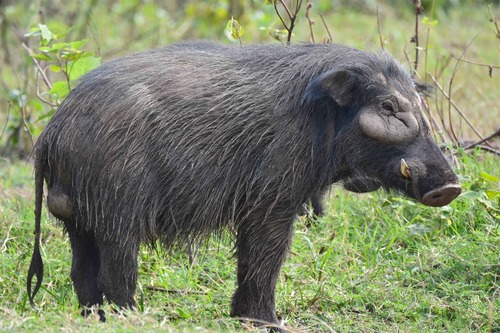
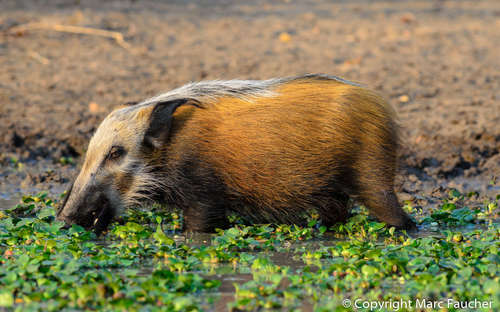
Adult bushpigs (Potamochoerus larvatus) measure 66 to 100 cm (26 to 39 in) at the shoulder. Mature boars most commonly weigh 60 to 80 kg (130 to 180 lb), though they can reach up to 150 kg (330 lb), while sows weigh 45 to 70 kg (99 to 154 lb). Males are typically larger than females. They resemble domestic pigs, and can be distinguished by their pointed, tufted ears and a distinctive face marking pattern called a face mask. Hair and skin color varies across the species' range: southern koiropotamus and nyasae populations are dark reddish, sometimes nearly black. Coat color darkens as individuals age. The face mask has a contrasting pattern of blackish to dark brown and white to dark grey markings, and may occasionally be entirely whitish. The ears have tassels of long hair, and their very sharp tusks are fairly short and not easily visible. Unlike warthogs, bushpigs run with their long, thin tails held down. Old males develop two warts on their snout. Newborn piglets have pale yellowish longitudinal stripes over a dark brown base; these stripes fade quickly, and the coat becomes reddish brown, with a black and white dorsal crest present in both sexes. This mane bristles when the animal is agitated. This species has a wide distribution: it occurs from Ethiopia and Somalia in the north, south to southeastern DR Congo, and continues south through the Cape and KwaZulu-Natal Provinces of South Africa, where it is mostly found in areas around Johannesburg and along the entire southern coast of the country. It also inhabits Botswana, Eswatini, Kenya, Malawi, Mozambique, Tanzania, Uganda, Zambia and Zimbabwe. Bushpigs also live on Madagascar, and possibly other islands in the Comoros archipelago. It is unknown how the species reached these islands, though it was likely transported there by humans, possibly after a short period of domestication. Numerous hybrids between bushpigs and domestic pig breeds have been reported. The bushpig's range in Botswana expanded during the late 1970s or early 1980s. In 1993, researchers speculated that the species' northern range has shrunk due to sahelisation, and the species is uncommon in Burundi. The main habitat requirement for bushpigs is dense cover, and they avoid open forests or savannas. They can be found in tall forests, montane forests, forest fringes, thick bushveld, gallery forests, flooded forest, swampland, or cultivated areas, and occur up to 4,000 metres in altitude on Mount Kilimanjaro. Bushpigs are fairly social animals, and live in groups called sounders that can have up to twelve members, with group sizes of three to five being most common. A typical sounder is made up of a dominant male, a dominant female, and the rest of the group consists of other females and juveniles. When different groups encounter each other, they engage in ritual aggressive behavior, but will fight over large food sources. Sounders have home ranges, are not territorial, and overlapping home ranges are common. Groups generally stay away from one another, and all intruders near the sounder, including non-bushpigs, are attacked. Home ranges are 400 to 1,000 hectares; the average home range in the Knysna forest region was 720 hectares. Almost half of the bushpig population are solitary wandering individuals. Small bachelor groups of young males also form, with ranges that overlap the ranges of several sounders, and young males avoid sounders to prevent confrontation. Litters have one to nine young, with three being most common. The full period from mating to the end of gestation lasts eight to ten months. When young males reach six months of age, the alpha sow will aggressively chase them away; she also does this to some one to two year old beta sows. Young males reach social maturity at 30 months of age. Mating occurs mostly in late autumn to early winter. Farrowing can happen at any time of year, but there is a clear peak in the warmest part of summer, which falls between October and February in South Africa. The alpha sow builds a nest three metres wide and one metre high during winter, using stacked hay, twigs, or flood-borne plant debris as bedding. She keeps the litter of piglets in this nest for approximately four months while they wean. Males are the main caregivers for the piglets, and sows only visit the nest to nurse the young. Sows have six teats. When foraging or alarmed, bushpigs snort and grunt harshly. They are primarily nocturnal, and hide in very dense thickets during the day. They never use aardvark burrows for shelter. Leopards are their main predator, and efforts to control leopard populations have led to an increase in bushpig numbers.