About Porzana fluminea Gould, 1843
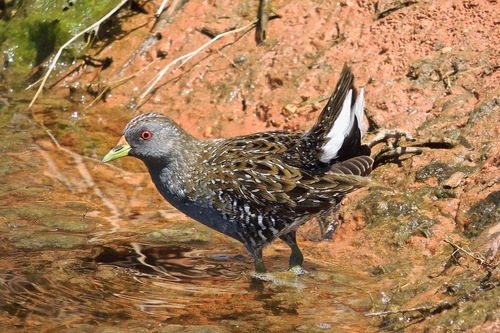
The Australian crake, scientifically named Porzana fluminea Gould, 1843, measures 19–23 cm (7.5–9.1 in) in length, weighs 55–70 g (1.9–2.5 oz), and has a wingspan of 27–33 cm (11–13 in). It shares similar appearance and behavior with Baillon's crake (Porzana pusilla), but is stockier and darker overall, and lacks Baillon's crake's distinctive barred undertail. The Australian crake has a sooty face, with steel-blue to dark grey throat, breast, and belly. Its upperparts, including the crown, are brown with black and white streaks, and its flanks have black and white barring. Shorter undertail coverts are black, while longer undertail coverts are white, which forms a distinctive upside-down V when the bird cocks its tail. The outermost primaries have a distinctly white leading edge that is visible during flight. Its bill is yellow-green with a red base on the upper mandible, and measures 1.8–2.1 cm (0.71–0.83 in). The legs and feet are also yellow-green, and the iris is red. While John Gould stated in *The Birds of Australia* that the sexes have so little difference in color that they can only be distinguished by dissection, females are actually slightly smaller and paler than males, have a brown stripe across the upper lores, and have more defined white spots on the breast and neck. Immature birds are paler than adult females, with white-fringed plumage on the belly and breast that appears as muted barring. Juveniles resemble adults but do not have the steel-blue or dark grey plumage; instead they have brown and white speckled underparts, a brown iris, and no red on the bill. Newly hatched chicks have very soft, downy black feathers with a deep green hue, and a distinctive red patch at the base of the upper mandible.
The Australian crake is endemic to Australia. It can be found across southeastern and Western Australia, and is less common in Tasmania and the tropical areas of northern Australia. It inhabits both coastal and inland habitats across freshwater, brackish, marine, and terrestrial environments, and prefers densely vegetated areas in marshes, swamps, estuaries, and saltmarshes that contain lignum, chenopods, rushes, and sedges. Its distribution and movement depend on water conditions, so its range can extend inland to areas such as Alice Springs/Mparntwe after periods of high rainfall.
Australian crakes usually forage in pairs, family groups, and sometimes in large groups of up to 100 individuals when food is abundant. They favor foraging in densely vegetated areas among reeds, on mudflats, or in shallow water less than 5 cm deep. They eat a wide variety of food, including aquatic plants, algae, seeds, molluscs, crustaceans, spiders, tadpoles, and adult and larval insects from the orders Dermaptera, Orthoptera, Coleoptera, Diptera, Lepidoptera, and Hymenoptera. They forage by probing the ground, wading, swimming, submerging their heads underwater, and knocking larger food items against the ground at the water's edge.