About Porzana flaviventer (Boddaert, 1783)
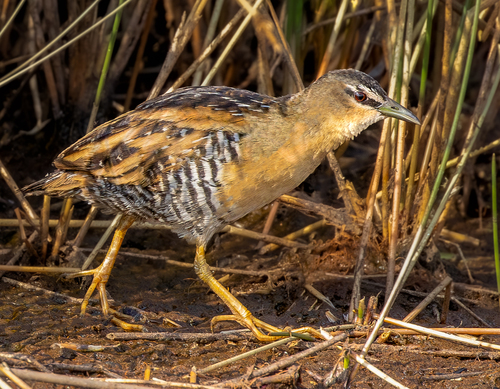
The yellow-breasted crake (Porzana flaviventer (Boddaert, 1783)) measures 12.5 to 14 cm (4.9 to 5.5 in) in length. Males weigh 22 to 29 g (0.78 to 1.0 oz) and females weigh 20 to 28 g (0.71 to 0.99 oz). The sexes have identical plumage. This species has a generally buffy face with a dark line through the eye and a pale buff-white supercilium, a facial pattern unique among New World members of the Rallidae family. Adult birds of the nominate subspecies P. f. flaviventer have brown upperparts, a white throat, a buffy yellow breast, and black and white banded flanks and belly. All other subspecies differ from the nominate in size and color intensity. The nominate subspecies and P. f. gossii are the largest of the five subspecies, and the nominate has the darkest neck and breast. P. f. bangsi has the darkest upperparts, while P. f. hendersoni has the palest upperparts.
The five subspecies of yellow-breasted crake have the following distributions: P. f. gossii occurs in Cuba and Jamaica; P. f. hendersoni occurs in Hispaniola and Puerto Rico; P. f. woodi occurs from central Mexico south to northwestern Costa Rica; P. f. bangsi occurs in northern Colombia; P. f. flaviventer occurs from Panama east through northern and central Colombia and Venezuela to the Guianas, and south through parts of Brazil, eastern Bolivia, Paraguay, and Uruguay into northeastern Argentina; it is also found on Trinidad and Tobago. Undocumented sight records from Ecuador have led the South American Classification Committee (SACC) of the AOS to classify this species as hypothetical in Ecuador. The SACC also notes that the species is a vagrant in Uruguay, not a permanent resident. The yellow-breasted crake is primarily found in freshwater habitats, and only rarely occurs in saltwater. It inhabits marshes, grassy edges of ponds and lakes, rice fields, and flooded grassy fields. Its elevational range extends from sea level up to 2,500 m (8,200 ft).