About Portunus segnis (Forskål, 1775)
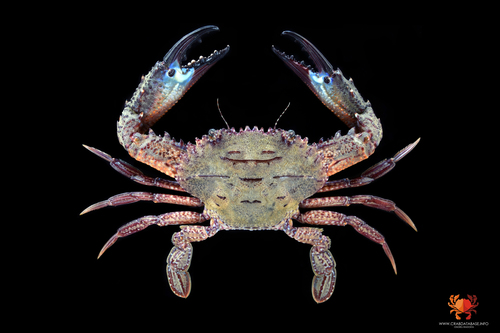
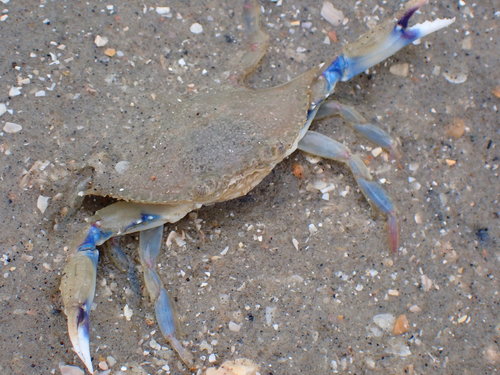
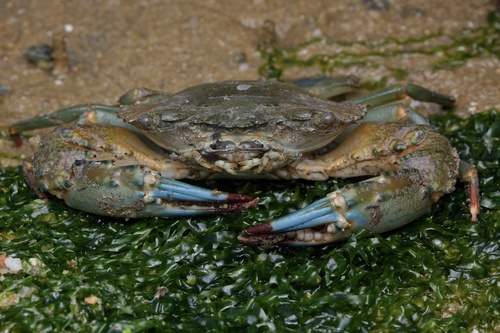
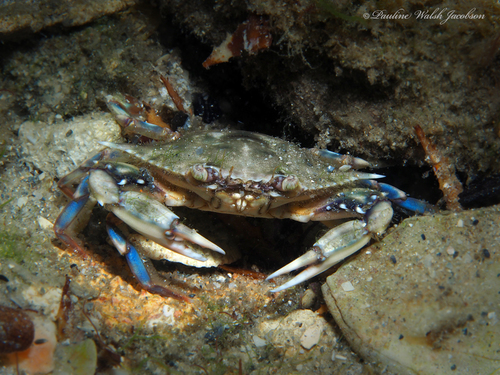
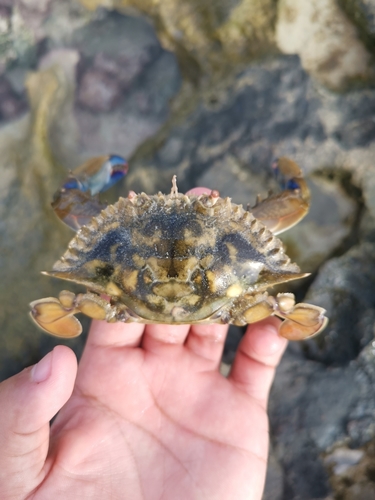
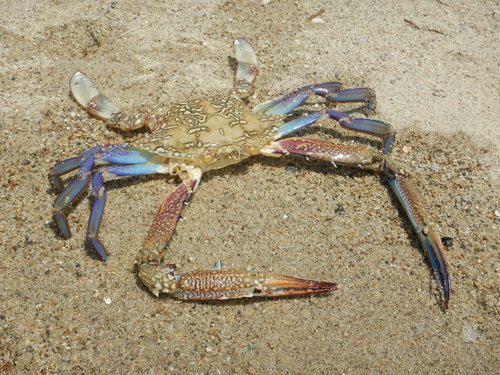
Portunus segnis males have a dark olive green-blue carapace marked with numerous pale white spots, especially towards the rear and along the sides. These spots typically do not join to form reticulated bands; if such bands are present, they are usually thinner than the bands seen in the closely related species P. pelagicus. Females are similar to males in overall appearance, except the tips of their legs are red with a brownish-red tinge, rather than blue with an intense rusty red tinge. The largest recorded specimen was an egg-bearing female, measuring 187.8 mm × 84.3 mm (7.39 in × 3.32 in).
In terms of distribution and habitat, Portunus segnis is native to the western Indian Ocean, ranging from the eastern African coast and the Red Sea east to Pakistan, and south to Madagascar and Mauritius. It was first recorded in the Mediterranean Sea in 1898 at Port Said, Egypt, and was one of the first documented Lessepsian migrants to enter that sea. It has since spread as far west as Italy and the Gulf of Gabes in Tunisia. Portunus segnis occurs mainly in coastal waters, within seagrass beds and mangroves. It is frequently found under rocks, in rock pools, and on sand or mud seabeds. This species is most abundant at depths between 2 and 15 m (6 ft 7 in and 49 ft 3 in). Small juveniles live at depths of less than 1 m (3 ft 3 in), while mature females move to deeper water to spawn.