About Portunus pelagicus (Linnaeus, 1758)
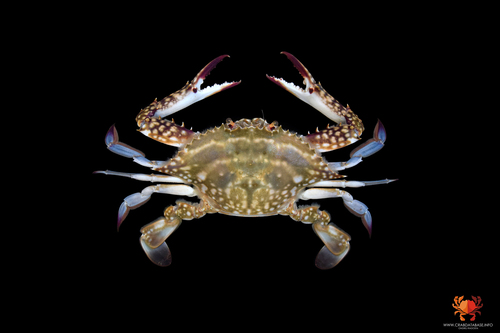
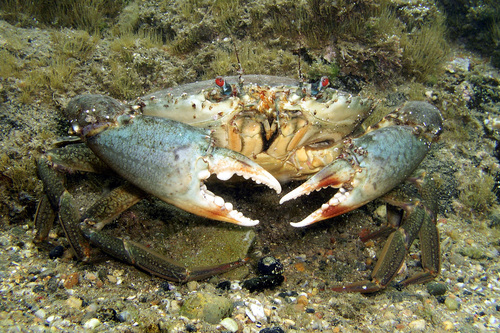
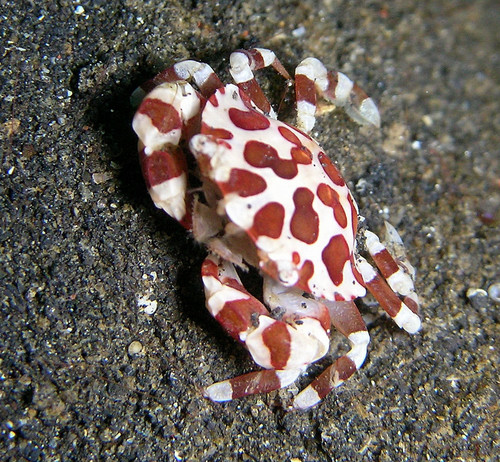
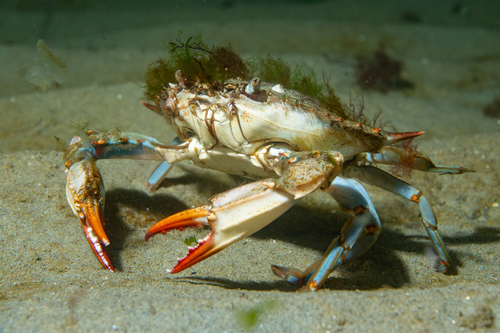
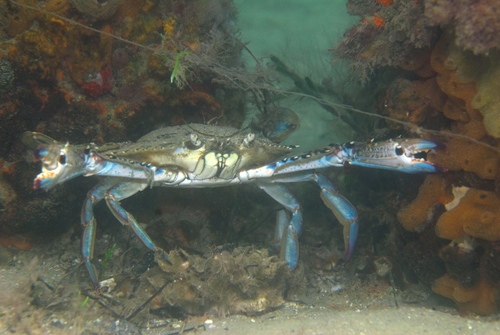
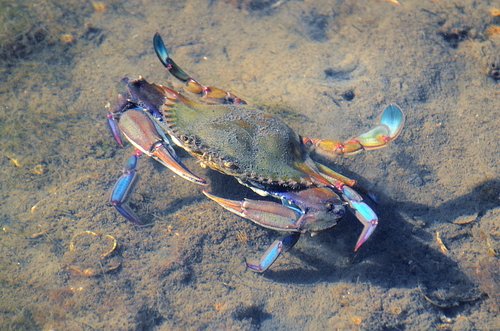
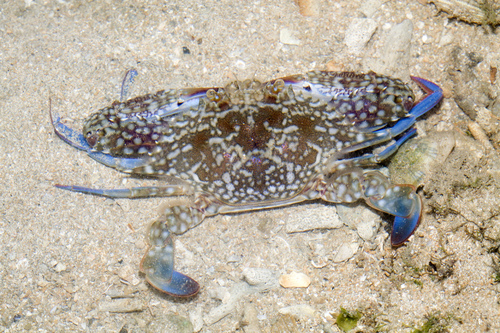
Males of Portunus pelagicus are bright blue with white spots, and have characteristically long chelipeds. Females have a duller green or brown color, and a more rounded carapace. The carapace can reach up to 20 centimeters (7.9 inches) in width. P. pelagicus commonly enters estuaries to find food and shelter. Its entire life cycle is dependent on estuaries, as larvae and early juveniles rely on these habitats for growth and development. Before eggs hatch, the adult female moves to shallow marine habitats to release her eggs. Newly hatched zoea I larvae then move into estuaries, where they feed on microscopic plankton. They develop from the zoea I stage through to the zoea IV stage over approximately 8 days, after which they progress to the final larval stage called megalopa, which lasts 4 to 6 days. The megalopa larval stage is defined by large chelipeds that it uses to catch prey. After megalopa metamorphoses into the juvenile crab stage, crabs continue to stay in estuaries, which provide suitable shelter and access to food. However, evidence shows that early juveniles cannot tolerate low salinity levels for extended periods, which is likely caused by their weak hyper-osmoregulatory abilities. This limitation may explain why early juveniles emigrate en masse from estuaries to seawater during the rainy season. Male Portunus pelagicus are thought to become more territorial in colder water. This may explain why male crabs are rarely seen close to one another in more temperate waters, and why female P. pelagicus appear to be more numerous in these areas.