About Portulacaria afra Jacq.
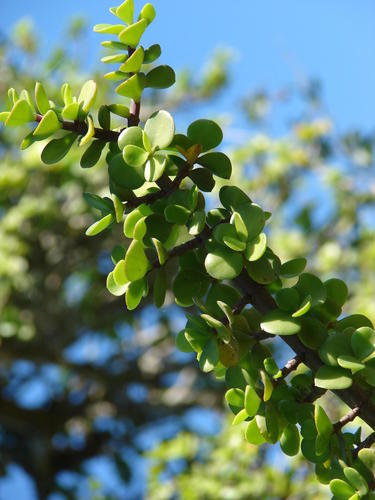
Portulacaria afra Jacq. is a soft-wooded, semi-evergreen upright shrub or small tree, typically growing 2.5 to 4.5 metres (8 to 15 feet) tall. Compared to Crassula, it has smaller, rounder pads, more compact growth with shorter internodal spaces that can be as small as 1.5 millimetres (0.059 inches). Once established, it is hardier, grows faster, has looser branching, and features more limber, tapering branches than Crassula. Research has found that the genus Portulacaria is an outlier that is not closely related to other genera in its family; all other genera in the family are restricted to small ranges in the arid far west of Southern Africa. This species is very widespread in eastern South Africa, as well as in Eswatini. In this moister regional climate, it is relatively uncommon, and it typically grows in drier rocky outcrops and on slopes. It also grows in much denser populations in the drier southern Cape. In this region, it occurs from the Little Karoo of the Western Cape, eastward to the thicket vegetation of the Eastern Cape. It is most abundant in Albany thickets, a woodland ecoregion often locally called noorsveld, named for the many succulent Euphorbia species (called noors plants) that grow there. In these environments, P. afra is a food source for multiple large herbivores, including black rhinoceros and African elephant. While it is not the primary food source for these animals, it still makes up a significant portion of their diet. P. afra is classified as a keystone species in the shrubland thicket subregions of the Albany thickets, because it is resistant to drought, flood, and fire. When it is not the dominant species, spekboom (the common name for P. afra) grows along the borders of shrubland thickets and protects the vegetation growing inside these areas. Its growth rate does not depend on water availability, and it can accumulate more biomass than would be predicted based on the area's annual rainfall. Despite its ecological importance, regional ecologists are advised not to introduce spekboom to subregions where it does not naturally occur, because it can gain biomass very rapidly. In its native South African wild habitat, large plants survive winter frosts by growing densely enough to create their own natural protective cover. It is drought-tolerant and fire-resistant, and can withstand desert sun and heat once established—conditions that the jade plant cannot tolerate. P. afra is a common landscape plant in Phoenix, Arizona, and southern California, where it grows in USDA plant hardiness zones 9 through 11. Cuttings of the species root very easily in most types of potting media. In rural areas of its native range where people lack easy access to modern medicine, this plant is one of many used in traditional treatments for skin conditions.