About Portulaca pilosa L.
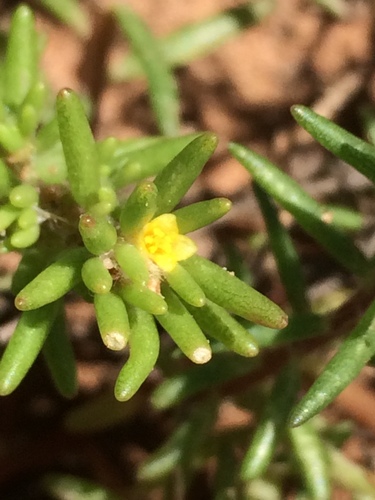
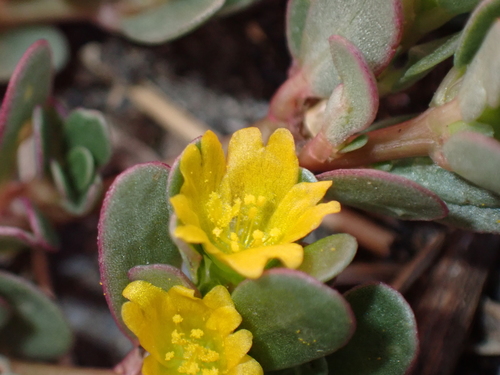
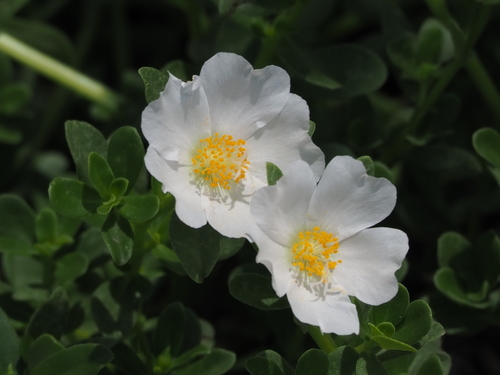
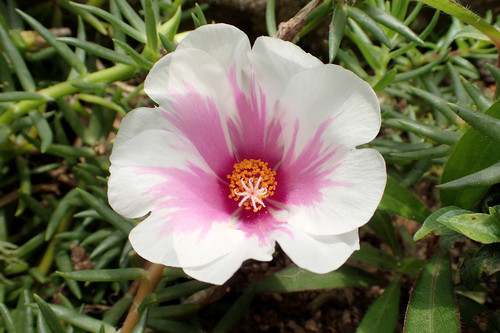
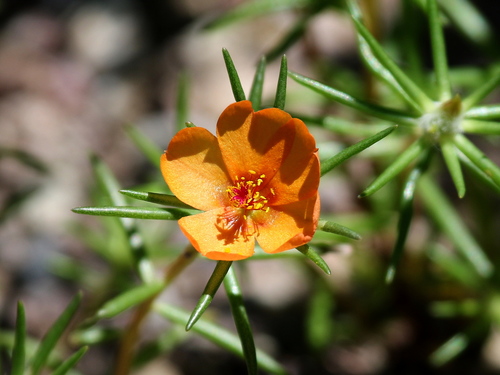
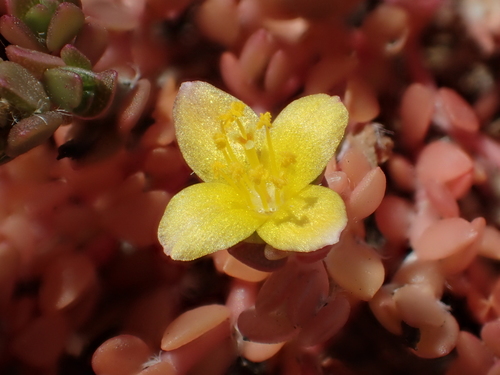
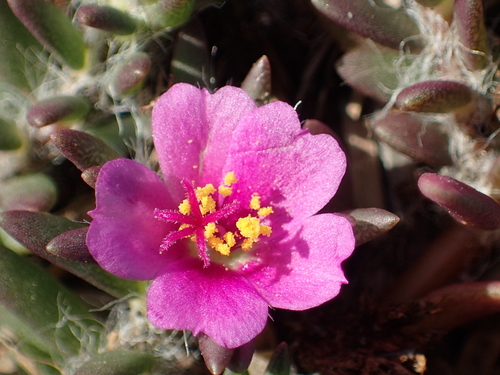
The scientific name Portulaca pilosa L. comes from the word "pilose", meaning covered with long soft hairs. Portulaca pilosa is a highly morphologically variable species that changes in form throughout its development. Immature plants have wider, longer, and flatter leaves than mature plants, whose leaves are narrower, shorter, and more hemispheric in cross-section. Morphological differences also arise from the different habitat types the species grows in. Plants growing in arid environments typically have the highest density of hairs, while plants in moist environments tend to have fewer hairs. This growth variability is demonstrated by plants that originally had very dense hair producing less hair when grown under moist conditions. The overall growth habit of the plant is also shaped by its habitat. Plants in moist, warm environments tend to branch quickly to develop a spreading growth habit, with erect secondary growth later. By contrast, plants in dry and cool environments grow erect first, then branch more slowly, and develop a more compact growth habit. Specimens collected from Alabama, Arizona, Florida, Louisiana, Mississippi, Texas, and New Mexico display all documented morphological forms of the species. Specimens from Arkansas, Kansas, Missouri, and Oklahoma usually grow in shallow, sandy soils, often on rocky outcrops, and are typically highly branched, compact, short, and not very hairy. Portulaca pilosa is an annual plant that flowers from late spring to early fall across most of its range, and grows and flowers year-round in southern Florida. This species is somewhat unusual for its ability to grow in a wide range of different environments, including dry soils, beaches, disturbed habitats, roadsides, railroads, and limestone, granitic, and sandstone outcrops. Portulaca pilosa is a pantropical species. Some sources state it is native to the Americas, while others list its native range as Asia, and still others state it is native to both regions. In the Americas, it can be found in Mexico, the West Indies, Central America, and as far south in South America as Brazil. In the United States, it is typically concentrated in southern states including Arkansas, Texas, New Mexico, Florida, and Mississippi, among others. Portulaca pilosa is a documented invasive species throughout the Hawaiian Islands, the Galapagos Islands, New Caledonia, and Christmas Island, according to a 2012 record from PIER.org. In Hawaii, it is officially documented growing from coastlines up to dry lava flows at over 610 meters in elevation, and can also be found at up to nearly 1,800 meters in the Pohakuloa Saddle region. In Cuba, this species is commonly called "Diez de la Mañana", which translates to the 10 a.m. flower. In other Latin American countries, it is known as "Flor Diez del Día." In Brazil, Portulaca pilosa has been used as a traditional remedy to induce diuresis, reduce fever, and relieve pain. Studies have found that extracts of this species have renal effects. In rat studies, these extracts were found to cause increased potassium excretion, with no corresponding change in water diuresis or sodium excretion.