About Portulaca oleracea L.
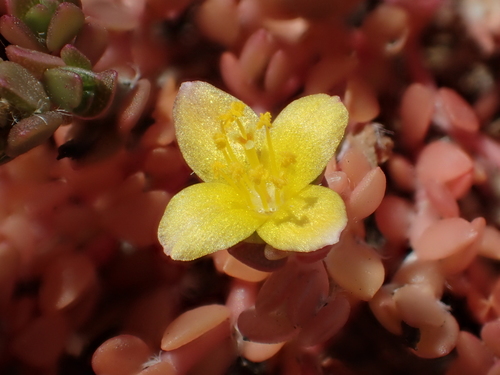
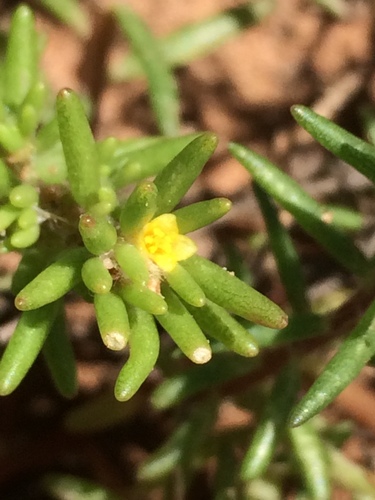
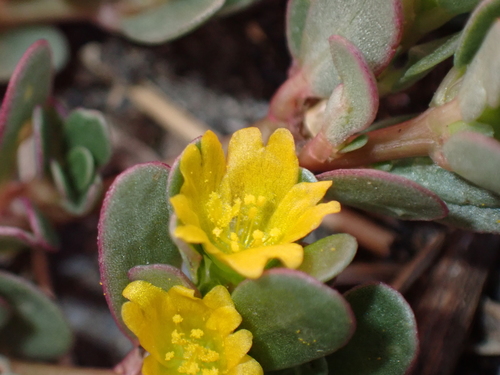
Portulaca oleracea L. (purslane) grows from a taproot, with fibrous secondary roots. Mature plants can reach up to 40 centimetres (16 inches) in height. It has smooth, reddish stems that are mostly prostrate. Its leaves, which can be arranged alternately or oppositely, are clustered at stem joints and stem ends. The yellow flowers have five regular structural parts and grow up to 6 millimetres (1⁄4 inch) wide. Depending on rainfall, flowers can appear at any time of year. Individual flowers open at the center of a leaf cluster for only a few hours on sunny mornings. Tiny seeds develop in a pod that splits open when the seeds reach maturity; the fruits are many-seeded capsules. This species produces a large number of seeds, with large plants reported to produce up to 240,000 seeds. Seeds germinate best at temperatures above 25 °C. They require light to germinate, and even a 5 mm layer of covering soil negatively impacts their germination rate. Although it is usually an annual plant, it grows as a tropical perennial in United States Department of Agriculture growing zones 10–11.
Purslane has an extensive distribution, thought to be mostly anthropogenic (also called hemerochoric). Its range extends from North Africa and Southern Europe, through the Middle East and the Indian subcontinent, to Malesia and Australasia. The native status of this species in the Americas is uncertain. In general, it is often considered an exotic weed, but evidence from Crawford Lake deposits in Ontario shows it was present between 1350–1539 CE, which suggests it reached North America in the pre-Columbian era. Scientists have suggested that the plant was already consumed by Native Americans, who spread its seeds. The route of its arrival in the Americas is currently unknown.
The taproot of purslane allows the plant to tolerate poor soil and drought conditions. Compared to other common crop plants, P. oleracea has higher pest tolerance, thanks to its waxy outer covering that protects it from insects and diseases. In some cases, P. oleracea is known to have antifungal properties. However, certain phytotoxic metabolites produced by the fungus Drechslera indica can cause necrosis on purslane. Another fungus, Dichotomophthora portulacae, can cause stem rot in the plant. P. oleracea is a confirmed host plant for Hyles lineata. Schizocerella pilicornis and Hypurus bertrandi are known to feed on Portulaca oleracea. In some cases, these feeding insects can reduce the competitiveness of P. oleracea to prevent weed infestation in areas where P. oleracea is not wanted, though they cannot stop it from growing entirely.