About Portulaca grandiflora Hook.
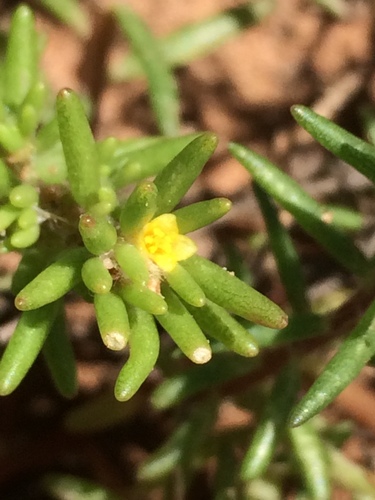
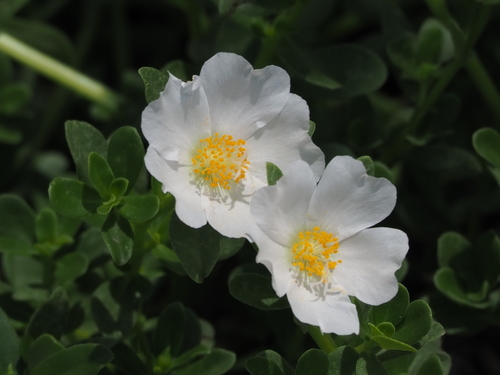
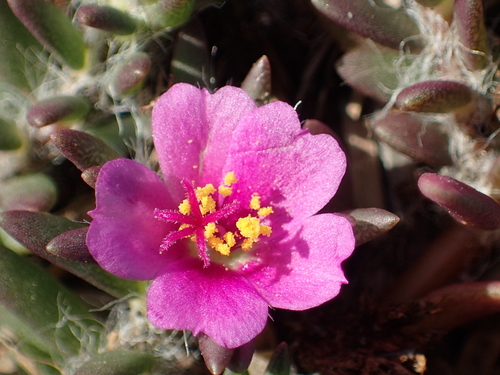
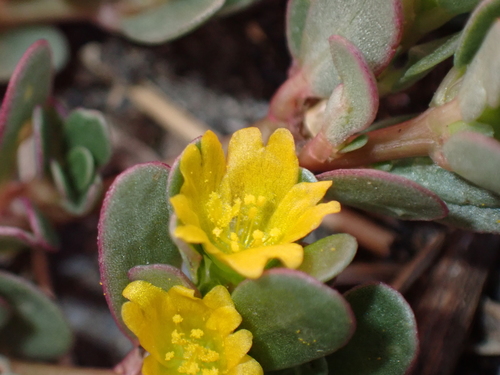
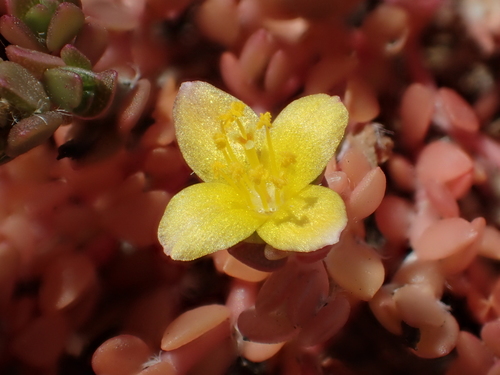
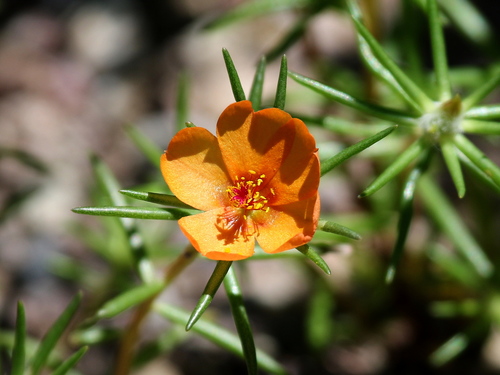
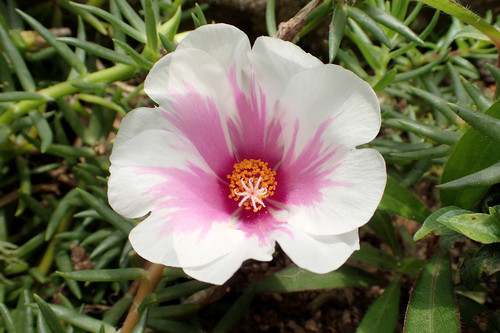
Portulaca grandiflora Hook. is a small, fast-growing annual plant. It usually grows under 30 cm tall, but can easily reach this height when cultivated properly. Its leaves are thick and fleshy, growing up to 2.5 cm long, and arranged alternately or in small clusters. Shoots are upright or ascending, and usually branch near the base. Spreading leaves are 20 to 25 millimeters long and 2 to 3 millimeters wide, almost or completely stalk-shaped, and taper towards the tip. Axillary leaves have few to numerous whitish woolly hairs, which are usually shorter than the leaves. Compressed inflorescences are surrounded by eight to ten leaves. Flowers have a diameter between 2.5 to 3 cm, with five petals in variable shades of red, orange, pink, white, and yellow; large flowers can reach up to 4 cm in diameter. The five bright magenta petals are obovate and 15 to 26 millimeters long. Around the ovary, which has four to nine whitish scars, there are about 50 stamens. Capsules and seeds are not visible on this description. P. grandiflora is one of the few plants that are C4/CAM intermediates, using both C4 carbon fixation and Crassulacean acid metabolism pathways for photosynthesis in different cells.
Numerous cultivars have been selected to produce double flowers with additional petals, and to achieve variation in flower colour, which can be plain or variegated. It is widely grown as an ornamental plant in temperate climates for annual bedding or as a container plant. It requires ample sunlight, well-drained soils, and almost no maintenance, and spreads itself very easily. It can grow between stones of roads or sidewalks in areas with old architecture, and naturally grows on sandy soils. In frost-free climates, it grows wild. Unlike Portulaca oleracea and Portulaca umbraticola, P. grandiflora is not edible due to its bitter taste. Hybrids exist between P. grandiflora and P. oleracea, P. umbraticola, and P. villosa. Honeybees visit this plant to collect its pollen and nectar. Seeds are often sold as mixed batches, such as the Double Flowering Mixture.