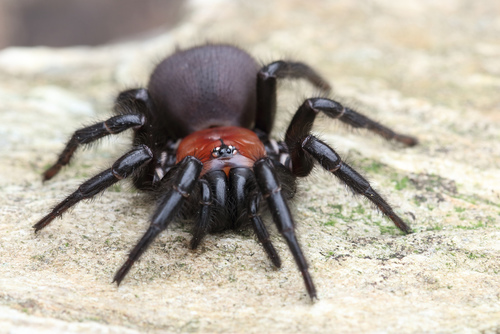
About Porrhothele antipodiana (Walckenaer, 1837)
Porrhothele antipodiana (Walckenaer, 1837) shows distinct physical traits between sexes. In females, the carapace is typically orange-brown, with darker shading near the eyes. The legs and palps are also usually orange-brown, but darker than the carapace. Chelicerae range from reddish-brown to black, the sternum is a pale reddish brown, and the abdomen is a uniform purple-black that may have faint chevron patterns which are more visible in juveniles. The openings of the two pairs of book lungs are ringed with cream. Females are the larger sex; body size is variable, but can exceed 30 mm. In males, the carapace is often darker than that of females. The legs, palps, and chelicerae are dark reddish brown, and the chelicerae are sometimes black. The abdomen is also darkly colored, similar to the female abdomen. Males can be told apart from females by the clasping structures on their first pair of legs, which are used to hold females during copulation. This species is often confused with species from the genus Hexathele, which lives in similar habitat and builds similar webs. The two can be most easily differentiated by the number of spinnerets: Porrhothele antipodiana has two sets of spinnerets, while Hexathele has three sets. As the common name tunnel web spider suggests, these spiders build long, non-sticky tunnel-shaped webs, most often under logs and rocks. They may also build webs in tree trunks, on rock faces, and in urban structures. Tunnels can reach up to 25 cm long and 3-4 cm wide, and usually have just one opening with widely spread silk that alerts the spider when prey is caught. These tunnel webs can be spun as quickly as within one hour. Porrhothele antipodiana is the most widespread species in the genus Porrhothele, and is found throughout both main islands of New Zealand. In the North Island, it does not appear to occur in the Northland region, where Porrhothele quadrigyna is known to live. It is broadly distributed across the South Island, with the exception of the alpine zone. The species is also present in the Chatham Islands, but this is thought to be a recent human-mediated introduction. This spider lives in a wide range of habitats. It is typically found under old logs and rocks, but will also build webs on cliffs and rock faces where conditions allow. It most commonly occurs in forests, but is also found in sand dunes, gardens, and hillsides with clusters of rocks.

