About Porpita porpita (Linnaeus, 1758)
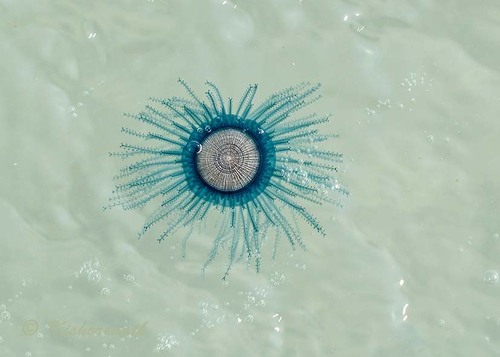
The blue button, scientifically named Porpita porpita (Linnaeus, 1758), can grow up to 30 millimeters in diameter and lives on the sea surface. Its body is made up of two main parts: the float and the hydroid colony. The hard golden brown float is round, nearly flat, and about one inch wide. This float controls the organism's vertical movement, and it has pores that allow communication with other Porpita porpita individuals and the surrounding environment. The polyps of the hydroid colony can range in color from bright blue turquoise to yellow. These polyps look similar to jellyfish tentacles. Each strand has many branchlets, and each branchlet ends in a knob of stinging cells called nematocysts at its distal end. A single mouth is located under the blue button's float; this opening is used both to take in prey and expel waste. The mouth is surrounded by a ring of gonozooids and dactylozooids. Tentacles only grow on the dactylozooids, which are positioned furthest from the mouth, towards the outer edge of the hydroid colony. The blue button is a component of the neustonic food web, which includes all organisms that live on or near the ocean surface. It is a passive drifter, meaning it depends on wind and water currents to move through the ocean. Its predators include the sea slug Glaucus atlanticus (also called the sea swallow or blue dragon), violet sea-snails from the genus Janthina, and Glaucus marginatus, the other known blue dragon. Unlike Velella, which follows a passive diet, Porpita porpita actively hunts prey such as crabs and fish. It competes with other ocean surface drifters for food, and feeds mainly on copepods and crustacean larvae.