About Porpidia macrocarpa (DC.) Hertel & A.J.Schwab
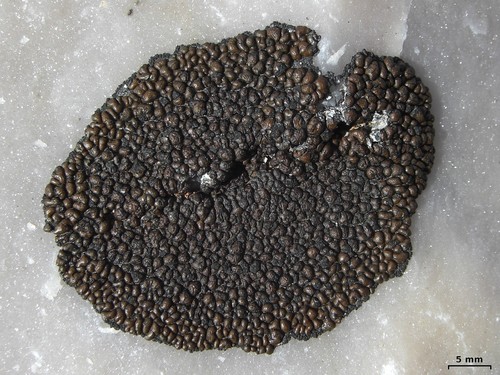
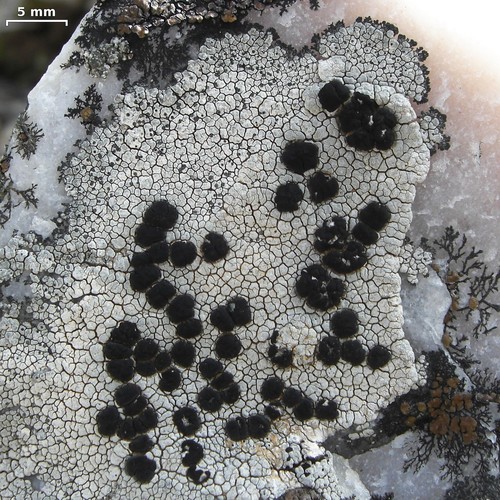
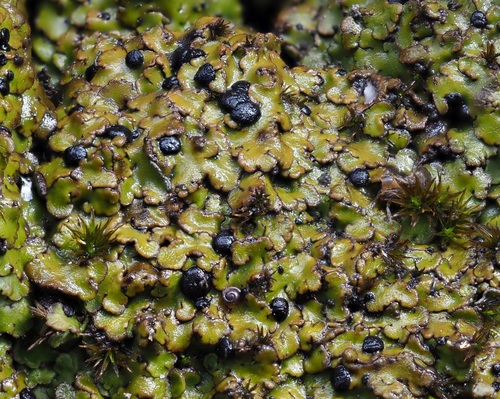
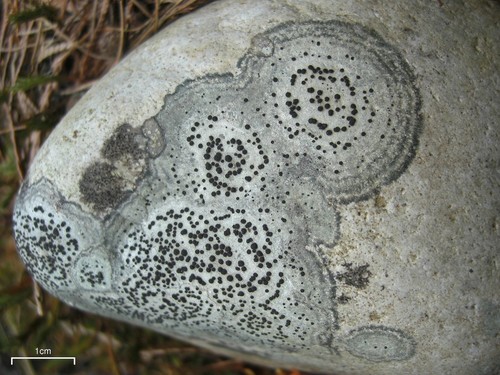
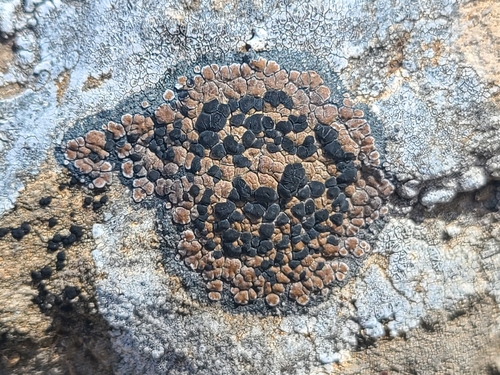
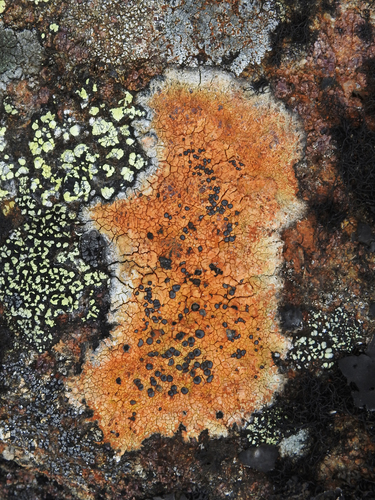
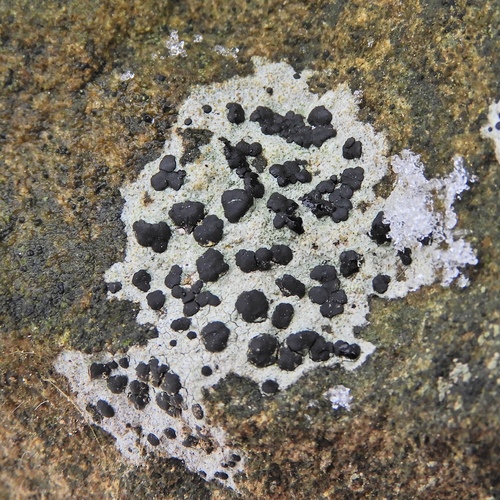
Porpidia macrocarpa is a crustose lichen with a variable thallus, which is typically either immersed (embedded in the substrate) or thin and continuous. It can occasionally grow thicker, and take on a cracked (rimose) texture or become split into small sections (areolate). The thallus surface is rough and web-like (subarachnoid), and ranges in colour from pale grey to greenish-grey. It often develops orange to rust-red patches or continuous discoloration caused by oxidation. Its internal tissue, the medulla, does not react to iodine (I–). The prothallus, the lichen’s initial growth stage, is indistinct along the margins of immersed thalli, but becomes wavy, black, and somewhat distinct at the margins of more superficial thalli. The apothecia (fruiting bodies) of Porpidia macrocarpa grow up to 3 mm in diameter. They are usually sessile (attached directly to the thallus), abundant, and can occur either scattered across the thallus or crowded close together. They are constricted at the base, with a thick, swollen persistent true exciple (rim) that is black, shiny, raised, and ranges from entire to somewhat wavy (flexuose). The filamentous fungal cells (hyphae) measure 3–9 μm in diameter. The disc of the apothecium ranges from slightly concave to flat or convex, is black or brown-black, and has either a matt or shiny finish; it is sometimes covered with a grey powdery coating called pruina. Larger apothecia often divide by forming secondary margins within their disc. The epithecium, the upper layer of the spore-producing hymenium, is pale brown to olive-brown, and the hymenium itself measures 80–100 μm tall. The hypothecium (the layer below the hymenium) and inner exciple may develop a reddish tinge when treated with potassium hydroxide solution (K+). The ascospores are elongated, and measure 16–20 μm in length and 6–11.5 μm in width. The medulla gives variable reactions to chemical spot tests: it sometimes produces a yellowish reaction with potassium hydroxide (K±) and an orange reaction with p-phenylenediamine (Pd±), which indicates the presence of stictic and cryptostictic acids.