About Porphyrio hochstetteri (A.B.Meyer, 1883)
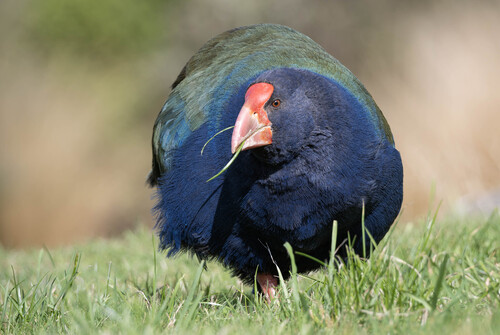
Porphyrio hochstetteri, commonly known as the South Island takahē, has a history of scientific discovery marked by early confusion over whether it was already extinct. In 1847, collector Walter Mantell sent fossil takahē bones found in South Taranaki, North Island, to anatomist Richard Owen. In 1848, Owen created the genus Notornis (meaning "southern bird") for these fossils, naming the new species Notornis mantelli, and Western science presumed the bird was already extinct like the moa. Two years later, a group of sealers encountered a large living bird at Tamatea / Dusky Sound, Fiordland. They chased it with dogs, described it running at great speed that screamed loudly and fought violently when captured. The sealers kept it alive for three to four days on their schooner before killing it, roasting and eating the bird, which the whole crew declared delicious. Walter Mantell met the sealers by chance, obtained the bird's skin, and sent it to his father, palaeontologist Gideon Mantell. Gideon Mantell realized this was a living Notornis, a genus previously only known from fossils, and presented the specimen to a 1850 meeting of the Zoological Society of London. A second living specimen, caught by Māori on Secretary Island, Fiordland, was sent to Gideon Mantell in 1851. Māori had long known the takahē well, and travelled long distances to hunt it; the bird's common name comes from the Māori verb takahi, meaning to stamp or trample. Only two more South Island takahē were collected by Europeans in the 19th century. One was caught by a rabbiter's dog on the eastern shore of Lake Te Anau in 1879. It was purchased for £105 by what is now the State Museum of Zoology, Dresden, and destroyed during the World War II bombing of Dresden. Another takahē was caught by a dog named 'Rough', owned by musterer Jack Ross, also on the shore of Lake Te Anau, on 7 August 1898. Ross tried to revive the female takahē, but it died, so he delivered it to curator William Benham at Otago Museum. The specimen was in excellent condition; it was bought by the New Zealand government for £250 and put on display. For many years, this was the only mounted takahē specimen in New Zealand, and the only takahē on public display anywhere in the world. After 1898, hunters and settlers continued to report sightings of large blue-and-green birds they called "giant pukakis" (a reference to pūkeko, also known as Australasian swamphens). One group reported chasing a bird the size of a goose with blue-green feathers and the speed of a racehorse, but could not catch it. None of these sightings were authenticated, and no new full specimens were collected beyond fossil bones, so the takahē was officially considered extinct. The South Island takahē is the largest living member of the rail family Rallidae. It averages 63 cm (25 in) in total length, with an average weight of roughly 2.7 kg (6.0 lb) for males and 2.3 kg (5.1 lb) for females, and an overall weight range of 1.8–4.2 kg (4.0–9.3 lb). Standing height is around 50 cm (20 in). It is a stocky, powerful flightless bird with short strong legs and a massive bill that can deliver a painful bite to people who approach it unwarily. While it cannot fly, it sometimes uses its reduced wings to help clamber up slopes. South Island takahē have plumage, beaks, and legs in typical gallinule colouring. Adult plumage is silky and iridescent: the head, neck, and underside are mostly dark blue or navy blue, while the wings are peacock blue. The back and inner wings are teal and green, fading to olive-green on the tail, which is white underneath. Adults have a bright scarlet frontal shield, carmine beaks marbled with red tones, and scarlet legs that one early rediscoverer described as "crayfish-red". Males and females have similar appearance, though females are slightly smaller, and may have frayed tail feathers while nesting. Newly hatched chicks are covered in jet-black fluffy down, have very large brown legs, and a dark bill with a white tip. Immature takahē have duller colouring than adults, with a dark bill that turns red as they mature. South Island takahē are noisy birds. They have a non-directional warning womph call, which the species' rediscoverers compared to someone whistling through a .303 cartridge case, plus a loud clowp call. Their contact call is easily confused with that of the weka (Gallirallus australis), but is generally more resonant and deeper. The takahē prefers alpine grassland habitat, and still survives in the Murchison Mountains, where it was rediscovered. Small numbers have been successfully translocated to five predator-free offshore islands open to public viewing: Tiritiri Matangi, Kapiti, Maud, Mana, and Motutapu. Captive takahē are also viewable by the public at Te Anau and Pūkaha / Mount Bruce National wildlife centres. In June 2006, a pair of takahē were relocated to the Maungatautari Restoration Project. In September 2010, a pair of takahē named Hamilton and Guy were released at Willowbank Wildlife Reserve, marking the first time this species was held by an institution that was not part of the New Zealand Department of Conservation. In January 2011, two takahē were released in Zealandia, Wellington, and in mid-2015 two more takahē were released on Rotoroa Island in the Hauraki Gulf. Additional takahē have been relocated to the Tawharanui Peninsula. In 2014, two pairs of takahē were released into Wairakei golf and sanctuary, a private fenced sanctuary north of Taupō at Wairakei, and the first chick was born there in November 2015. By October 2017, 347 takahē were accounted for, a 41-individual increase over the 2016 count. Orokonui Ecosanctuary hosts one breeding pair of takahē named Quammen and Paku. The pair successfully produced two chicks in 2018, but both chicks died from exposure after heavy rains in November 2018. Their deaths caused controversy over the ecosanctuary's "non-interference" management policy. In 2018, eighteen South Island takahē were reintroduced to Kahurangi National Park, 100 years after the species went locally extinct there. A second reintroduction to Te Waipounamu (South Island) was completed in August 2023, when eighteen takahē were released into the Upper Whakatipu Waimāori Valley at Ngāi Tahu-owned Greenstone Station. Six more takahē were released onto the same property that October. The South Island takahē is a sedentary, flightless bird that lives primarily in alpine grasslands. It is territorial, and stays in alpine grassland until snow arrives, then descends to lower elevation forest or scrub. It feeds on grass, shoots, and insects, but predominantly eats leaves of Chionochloa tussocks and other alpine grass species. Takahē can often be seen plucking a stalk of snow grass (Danthonia flavescens), holding it in one claw, and eating only the soft lower parts that the bird favours, discarding the rest of the stalk. One takahē at Zealandia was recorded feeding on a paradise duckling. While this behaviour had not previously been recorded for takahē, their close relative the pūkeko (Australasian swamphen) occasionally feeds on the eggs and nestlings of other birds.