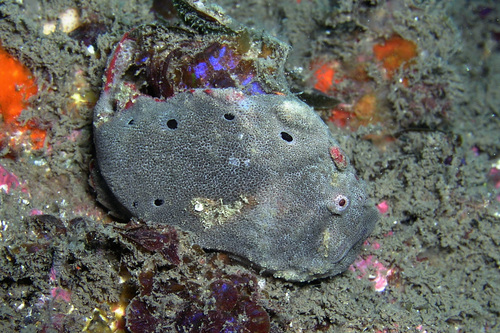
About Porophryne erythrodactylus Arnold, Harcourt & Pietsch, 2014
Porophryne erythrodactylus, commonly called the red-fingered anglerfish, is separated from its sister genus Kuiterichthys by the completely different morphology of its second dorsal spine. In this genus, the second dorsal spine is slender at its base, then suddenly expands to the sides, becoming almost quadrangular in shape. There is an obvious tuft of typically brightly coloured filaments on the midline of the lower lip; this may act as an additional lure, a feature not recorded in any other anglerfish. All 9 fin rays in the caudal fin are forked, there are 13 soft rays on the dorsal fin, and 7 soft rays in the anal fin. The whole body is covered in dermal denticles, with the exception of the fish's black spots. The illicium, which is the first dorsal spine, is equal in length to the second dorsal spine. The large, oval-shaped esca (the fish's lure) is tipped by two tufts of short filaments. This species has two distinct colour phases. The first phase is grey with scattered black spots on the head and body, and these spotted areas lack denticles. The second phase may be orange, red, pink, white, or a combination of these colours, has no black spots, and has skin appendages. The maximum published standard length for the red-fingered anglerfish is 7.4 cm (2.9 in).
The genus Porophryne is only known from waters off New South Wales, Australia, at scattered localities between Sydney Harbour and Jervis Bay. Recorded sites include Indian Point, Botany Bay at 6 m (20 ft) depth, Bare Island sponge gardens at 14 m (46 ft), South Head at 10 m (33 ft), one egg-guarding individual at Bass Point Shellharbour, and the Middleground in Jervis Bay at 24 m (79 ft). The red-fingered anglerfish is typically found in rocky-reef habitats below the low tide mark. These habitats are dominated by leafy and filamentous seaweed such as Zonaria, Corallina, Amphiroa, and Laurencia, and frequently have an admixture of Sargassum species and Ecklonia radiata. Vertical or sloping walls on the deeper edges of nearby reefs are inhabited by ascidians, corals and sponges, including Spongia sp., Tedania anhelans, Ephydatia fluviatilis, Darwinella australiensis, Chondrilla australiensis, Mycale australis and Holopsamma laminaefavosa. The red-fingered anglerfish has its closest association with small sponges, and camouflages itself by matching the appearance of algae-covered sponges in its rocky, subtidal habitat.

