About Poroderma pantherinum (Müller & Henle, 1838)
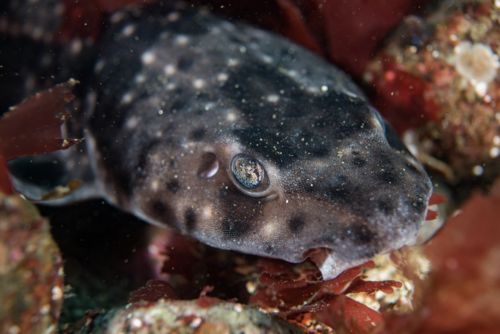
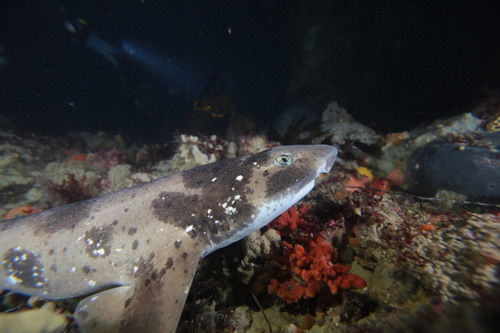
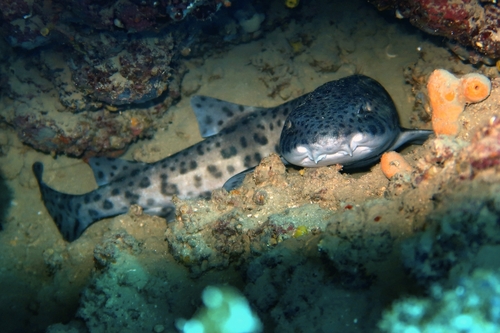
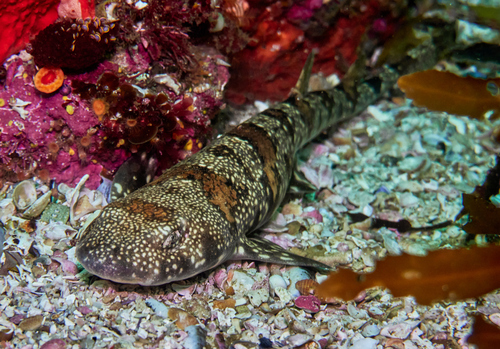
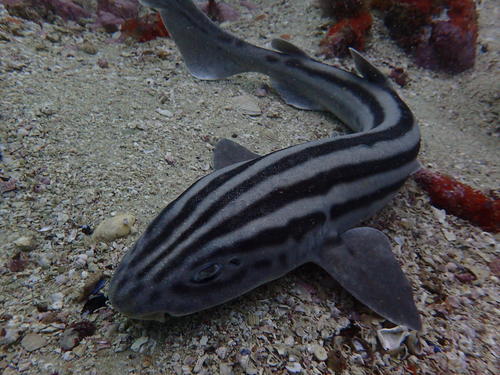
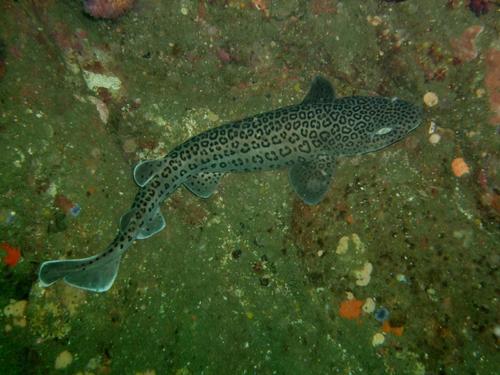
Poroderma pantherinum, commonly called the leopard catshark, is the smaller and slimmer of the two recognized Poroderma species. Its head and snout are short and slightly flattened, ending in a somewhat pointed snout tip. A three-lobed skin flap in front of each nostril splits the opening into tiny incurrent and excurrent openings; the central lobe of this flap forms a slender barbel that extends past the mouth. The horizontally oval eyes, which sit fairly high on the head, have rudimentary protective nictitating membranes (third eyelids), and a thick ridge runs under each eye. The mouth is wide and arched, with short furrows at the corners that extend onto both jaws. When the mouth is closed, the upper teeth remain exposed. There are 18 to 30 tooth rows on each side of the upper jaw, and 13 to 26 tooth rows on each side of the lower jaw. Each tooth has a narrow central cusp paired with two small lateral cusplets; the teeth of adult males are slightly more curved than those of females. The leopard catshark's body is somewhat laterally compressed and tapers toward the tail, with two dorsal fins placed far back on the body. The first dorsal fin originates over the rear of the pelvic fins and is much larger than the second dorsal fin, which originates over the midpoint of the anal fin base. The bases of the pectoral and pelvic fins are roughly equal in size: pectoral fins are large and broad, while pelvic fins are much lower. Adult males have stubby claspers, and the inner margins of the pelvic fins are partially fused over the claspers to form a structure called an "apron". The caudal fin is short and broad, with an indistinct lower lobe and a ventral notch near the tip of the upper lobe. The shark's very thick skin is covered in well-calcified dermal denticles. Each denticle has an arrowhead-shaped crown with three posterior points, mounted on a short stalk. The background color of the leopard catshark ranges from off-white to glossy jet black on the upper side, and white to almost black on the underside, sometimes with an abrupt transition between the two colors. Over this background is a distinct pattern of black markings that can combine small to large spots, blotches, complete or incomplete rosettes, and short to long lines; these markings may extend almost to the midline of the belly. Four named color forms are recognized: 'typical', which has leopard-like rosettes and broken lines; 'marleyi', which has large round spots; 'salt and pepper', which has densely packed dots; and 'melanistic', which has an almost completely black upper surface with irregular stripes and/or spots. Many individual sharks are intermediate between these named forms. Color pattern changes with development: all hatchling leopard catsharks have large black spots, and as the shark ages, these spots tend to break up into rosettes and smaller spots, which may eventually merge into lines. The 'marleyi' form appears to be an example of paedomorphosis, where the hatchling color pattern is retained into adulthood. Color pattern also correlates with geographic location: the 'marleyi' and 'salt and pepper' forms are apparently restricted to waters off the Eastern Cape and KwaZulu-Natal. This species reaches a maximum known length of 84 cm (33 in) and a maximum known weight of 3.2 kg (7.1 lb), and males grow slightly larger than females. The leopard catshark inhabits temperate and subtropical inshore waters off South Africa, ranging from Saldanha Bay in the west to the mouth of the Tugela River in the east. Older records of this species from Mauritius and Madagascar are almost certainly erroneous. Due to the species' high color pattern diversity, its range is likely fragmented into multiple small local populations along the South African coast. A bottom-dwelling species, the leopard catshark is most commonly found from the intertidal zone down to a depth of 20 m (66 ft), though it has been recorded as deep as 256 m (840 ft) on the uppermost portion of the continental slope. It prefers rocky reefs, kelp forests, and sandy flats off beaches. The leopard catshark is a slow-swimming species that generally spends the day resting inside caves or crevices, either alone or in groups. At night, it moves toward shore to actively forage for small bony fishes, cephalopods, crustaceans, and polychaete worms. In False Bay, fishes are the most important prey type for this species, followed by cephalopods, then Cape rock lobster (Jasus lalandii). The leopard catshark has been observed attacking octopus and cuttlefish by seizing and tearing off tentacles with a twisting motion. Like its close relative the pyjama shark, it will temporarily give up its nocturnal habits to feed during daytime mass spawnings of chokka squid (Loligo vulgaris reynaudi). These spawnings occur unpredictably year-round, with a peak from October to December. During these events, the sharks lie motionless among the squids' egg masses with their heads hidden, and make sudden lunges at female squid that have descended to the sea floor to attach their eggs. The leopard catshark is oviparous and appears to reproduce year-round. Females produce two eggs at a time, one in each oviduct. Each egg is protected by a rectangular capsule 7 cm (2.8 in) long and 3 cm (1.2 in) across. The capsule is light brown to olive in color and has thinner walls than the egg capsules of the pyjama shark. Long tendrils at the capsule's corners allow the female to secure the eggs to underwater structures. In aquarium settings, the eggs hatch after approximately five and a half months. Hatchlings measure 11 cm (4.3 in) long. Males reach sexual maturity at 47–67 cm (19–26 in) long, while females reach sexual maturity at 43–64 cm (17–25 in) long; this corresponds to an age of around 10 years. One source reports the maximum lifespan of the leopard catshark as at least 15 years, while another source reports it as at least 19 years. Predators of the leopard catshark include larger sharks and marine mammals; it is one of the cartilaginous fish most frequently consumed by the broadnose sevengill shark (Notorynchus cepedianus). When threatened, the leopard catshark curls into a ring with its tail covering its head, a behavior also seen in shysharks (Haploblepharus). Its eggs are also heavily preyed on by whelks such as Burnupena papyracea and B. lagenaria, which pierce the outer capsule to eat the yolk inside. This species is parasitized by the praniza larvae of the isopod Gnathia pantherina, which infest the nostrils, mouth, and gills.