About Poroderma africanum (Gmelin, 1789)
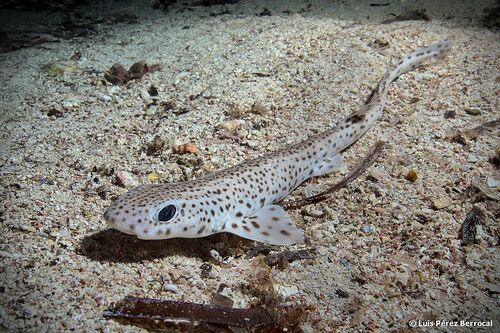
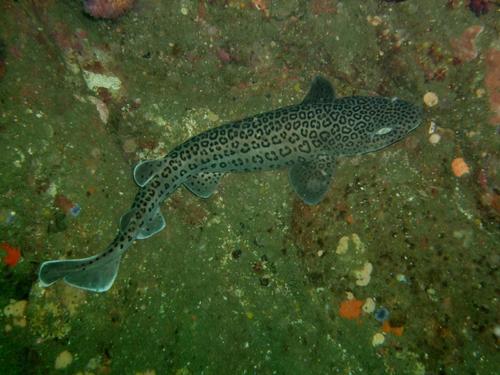
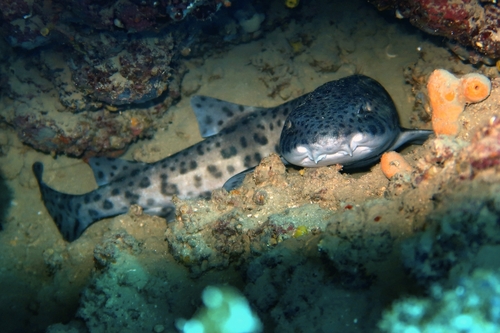
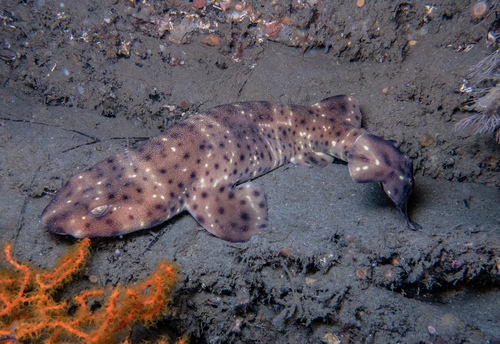
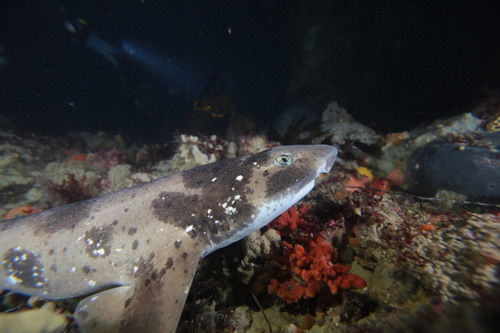
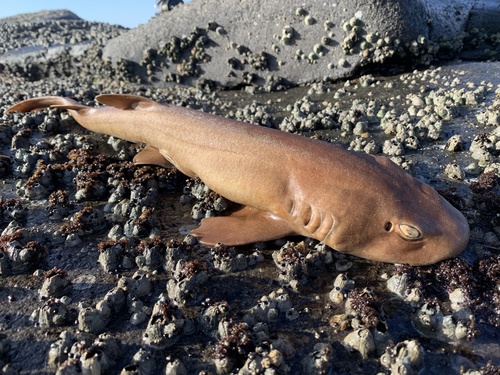
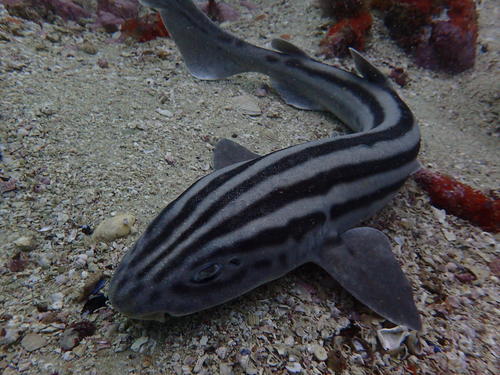
The pyjama shark, with the scientific name Poroderma africanum (Gmelin, 1789), is the larger, thicker-bodied of the two recognized Poroderma species. It grows to 1.1 m (3.6 ft) long and 7.9 kg (17 lb) or more in weight, and both sexes reach roughly the same maximum size. Its head and snout are short, slightly flattened, and have a narrowly parabolic outline when viewed from above or below. A skin flap in front of each nostril splits the opening into tiny incurrent and excurrent openings; this flap is three-lobed, with its central lobe forming a long, conical barbel. These barbels are thicker than those of the leopard catshark, and do not extend to reach the mouth. The pyjama shark’s eyes are horizontally oval, positioned rather high on the head, and have rudimentary nictitating membranes (protective third eyelids) with a thick ridge running underneath each eye. The large mouth forms a broad arch, with short furrows extending from the mouth corners onto both the upper and lower jaws; the upper teeth remain exposed when the mouth is closed. There are 18–25 tooth rows on either side of the upper jaw, and 14–24 tooth rows on either side of the lower jaw. Each tooth has a slender central cusp flanked by a pair of small cusplets, and teeth of adult males are slightly thicker than those of females. The pyjama shark’s body is fairly compressed side-to-side, and tapers toward the tail. Both of its dorsal fins are placed far back on the body: the first dorsal fin originates over the rear of the pelvic fins, while the second originates over the midpoint of the anal fin. The first dorsal fin is much larger than the second. The pectoral fins are large and broad. The pelvic fins sit lower than the pectoral fins, but their bases are about equal in length. Adult males have a pair of short, thick claspers, and the inner margins of the pelvic fins are partially fused over the claspers to form a structure called an "apron". The short, broad caudal fin has an indistinct lower lobe and a ventral notch near the tip of the upper lobe. The skin is very thick and bears well-calcified dermal denticles; each denticle has an arrowhead-shaped crown with three posterior points, mounted on a short stalk. The dorsal coloration is distinctive: it consists of 5–7 thick, parallel, dark stripes running from the snout to the caudal peduncle, over a variably grayish or brownish background. The stripes become broken near the tail and the belly. In some individuals, the main stripe on either side may fork behind the eye, stripes may be split in two by lighter central lines, or one or more large dark spots may be present. The underside is pale, sometimes with light gray spotting, and is clearly demarcated from the color of the flanks. Young pyjama sharks resemble adults, but may be much lighter overall or have much darker stripes. One albino specimen has been recorded from False Bay. The pyjama shark is a bottom-dwelling species that lives in temperate inshore waters off South Africa, ranging from Table Bay off Cape Town to north of East London. It is most abundant off the Western Cape, and may venture as far west as Saldanha Bay and as far east as KwaZulu-Natal. Old records of this species from Mauritius, Madagascar, and Zaire are almost certainly incorrect. It is commonly found in very shallow intertidal and littoral waters no more than 5 m (16 ft) deep, though in and around Algoa Bay it occurs at depths of 50–100 m (160–330 ft), and has been reported as deep as 108 m (354 ft). It favors habitats of rocky reefs and beds of Ecklonia kelp. The pyjama shark is a rather slow-swimming animal that spends most of the day resting in caves, crevices, or among kelp, and emerges at night to actively forage for food. Many individuals may congregate in a single resting spot, particularly during summer. This species is preyed on by larger sharks, and is one of the cartilaginous fish most frequently consumed by the broadnose sevengill shark (Notorynchus cepedianus). When threatened, the pyjama shark often curls into a circle with its tail covering its head, a defensive behavior similar to that of shysharks (Haploblepharus). Its eggs are eaten by whelks of the species Burnupena papyracea and B. lagenaria, which can pierce the egg capsule’s outer covering to extract the yolk inside. Like other sharks, the pyjama shark maintains osmotic balance with its environment by regulating the internal concentration of urea and other nitrogenous wastes. Experiments have shown that the shark’s osmoregulation capacity depends on how well it has been fed. The pyjama shark feeds on a wide variety of small prey, including bony fishes such as anchovies, gurnards, and hakes, as well as hagfishes, smaller sharks and rays and their egg cases, crustaceans, cephalopods, bivalves, and polychaete worms. It has also been recorded scavenging on fish offal. Although it has a preference for cephalopods, this opportunistic predator’s diet generally reflects the types of prey that are locally available. For example, in False Bay the Cape rock lobster (Jasus lalandii) is the most important food source, followed by cephalopods, then fish. Pyjama sharks have been observed seizing and tearing off tentacles from octopus and cuttlefish using a twisting motion; on one occasion, three sharks were seen attacking a single octopus at the same time using this method. During mass spawnings of the chokka squid (Loligo vulgaris reynaudi), which occur unpredictably year-round but peak between October and December, pyjama sharks abandon their usual nocturnal habits and gather in large numbers inside the squids’ egg beds during daytime. The sharks hide their heads within the egg masses, and their dark stripes break up the outlines of their bodies to help them stay concealed. When female squid descend to the sea floor to attach their eggs, guarded by male squid, they become vulnerable to the sharks’ ambushes. The pyjama shark is an oviparous species, and both males and females appear to be reproductively active throughout the year. Adult females have a single functional ovary and two functional oviducts, with one egg maturing in each oviduct at a time. Each mature egg is contained in a tough, rectangular, dark brown capsule that measures 9.5 cm (3.7 in) long and 4.5 cm (1.8 in) across, with long tendrils at the corners. These tendrils allow the female pyjama shark to fasten the egg capsule to underwater structures such as algae stipes or gorgonians. Eggs kept in aquariums hatch after approximately five and a half months, and newly hatched pyjama sharks measure 14–15 cm (5.5–5.9 in) long. Males begin reaching sexual maturity at 78–81 cm (31–32 in) long, while females begin maturing at 79–83 cm (31–33 in) long. All pyjama sharks are adult by the time they reach a length of 89 cm (35 in).