About Porodaedalea pini (Brot.) Murrill
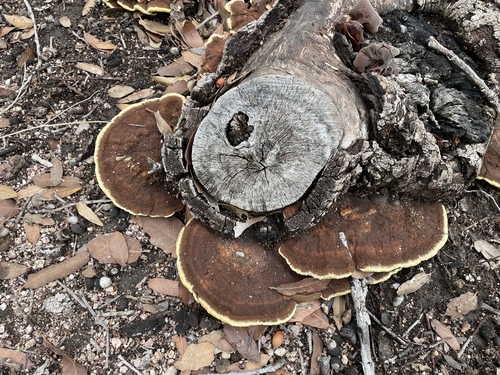
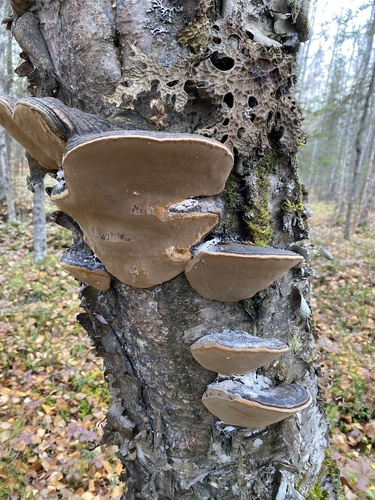
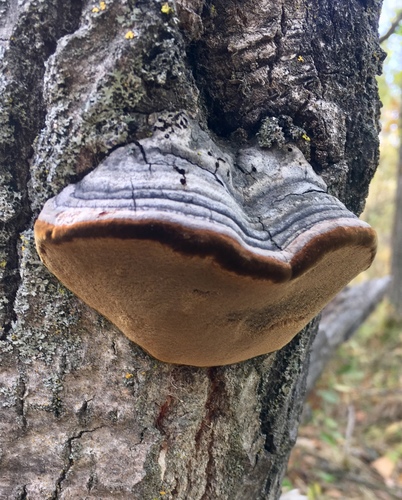
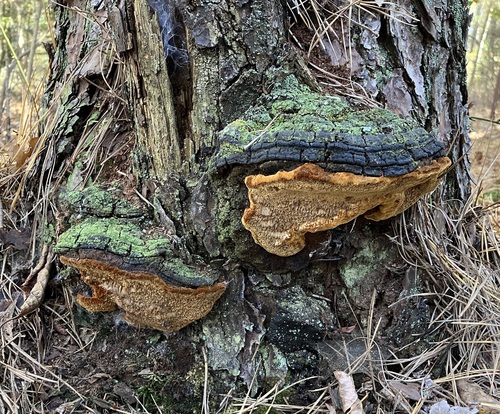
The most visible sign of Porodaedalea pini infection on host trees is its fruiting body, called a basidiocarp or conk. These conks are perennial, typically grow in clustered overlapping groups, form shelf shapes, and reach about 3 inches wide. The upper surface of conks ranges from reddish brown to blackish and marked with concentric furrows, while the lower pore-bearing surface is yellow-brown. Active growing conks have a bright yellowish-brown undersurface and margin, with large irregular pores. White decay pockets usually form in wood where conks develop, but decay can extend 4 feet above and 5 feet below the conk. Decay most often develops at the base of the tree stem, and can also spread into large roots. In early decay, affected wood takes on a reddish to purplish color, and a cross-section of affected wood shows a distinct well-defined ring. In advanced decay stages, Porodaedalea pini degrades lignin in wood to form small, spindle-shaped hollow white pockets that retain residual white cellulose after delignification. Like other polypores, this fungus produces basidiospores on the underside of conks, and these spores are dispersed by wind. Wind-dispersed spores act as the initial inoculum for the disease red ring rot. When spores land on an exposed small wound or twig stub, they can germinate, and their mycelia grow into the inner wood to cause infection. Porodaedalea pini only produces one type of spore: basidiospores, which are sexual spores. The fungus overwinters as mycelium inside diseased or dead trees, and new conks can form once decay has generated enough resources to support growth. It takes 10 to 20 years or more from initial infection for conks to form. Because conks are perennial, the disease cycle repeats when new conks produce their own spores. This species is not edible. A number of conditions promote the development and spread of disease caused by Porodaedalea pini. As a heart rot fungus, it enters trees through branch stubs, tree stumps, damaged roots, dead branches, and wounds in general, either as mycelium or basidiospores, then infects the tree’s heartwood. Wounds from fire and timber cutting are the most common points of entry for this fungus, and moist environments support its growth. Because wind-blown spores germinate on tree wounds, care should be taken to avoid injuring trees during harvest or other forest management activities in areas where the fungus occurs. The disease caused by Porodaedalea pini is most common in the Pacific Northwest, where cool wet weather supports pathogen growth. Red ring rot is common across North America, and the pathogenic fungus is widely distributed throughout temperate zones of the Northern Hemisphere. It infects a broad range of coniferous tree species, including jack pine, lodgepole pine, Sitka spruce, white spruce, Douglas-fir, balsam fir, true fir, western hemlock, and tamarack. It attacks both heartwood and sapwood and causes the disease white pocket trunk rot.