About Porlieria angustifolia (Engelm.) A.Gray
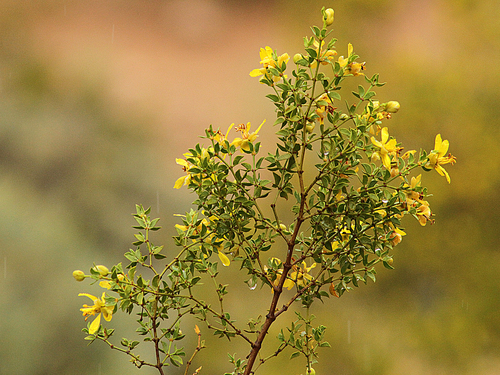
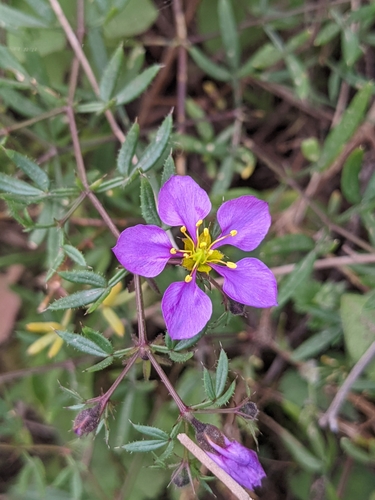
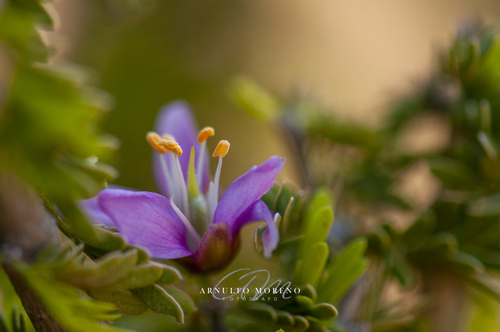
Porlieria angustifolia, commonly known as Texas lignum-vitae, is an evergreen multi-branched shrub or small tree that grows up to 7 meters (23 feet) tall. It has a dense canopy and short lateral branches. Its distribution includes parts of Texas and northern Mexico. In Texas, it occurs around the Rio Grande, ranging from Austin, Matagorda Bay, New Braunfels, San Antonio, Brownsville, and Fort McIntosh west to the Rio Pecos. In the 19th century, specimens growing on the outskirts of this range were small enough that the United States Department of Interior described them as "low shrubs", while the largest known specimens at that time grew on hillsides near the Guadalupe River valley. In Mexico, this species is found in the states of Chihuahua, San Luis Potosí, Coahuila, Nuevo León, and Tamaulipas. This species (formerly classified as Guaiacum angustifolium) acts as a host plant for caterpillars of the lyside sulphur butterfly, Kricogonia lyside. Its leaves contain 16 to 18% crude protein, and are browsed by white-tailed deer, Odocoileus virginianus. Like other species in its genus, the wood of Porlieria angustifolia is extremely hard and dense, and will sink in water. Its sapwood is creamy yellow, while its heartwood is dark purple-brown. The wood is used for fence posts, tool handles, and firewood. Root extracts are used to treat rheumatism and sexually transmitted diseases. The root bark contains saponin, so it can be used to make soap. Historically, this soap was used to wash wool because it does not cause dyed colors to fade. Root bark is also used as a disinfectant. Beekeepers value the flowers of this plant for their consistent nectar production. Due to its drought tolerance, dense foliage, compact size, gnarled branches, and fragrant flowers, Texas lignum-vitae is cultivated as an ornamental plant. It is used in hedges, rock gardens, and xeriscaping.