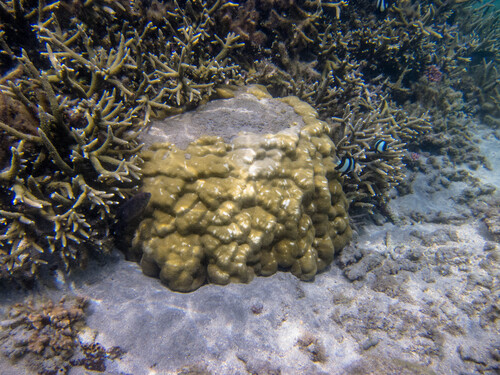
About Porites lobata Dana, 1846
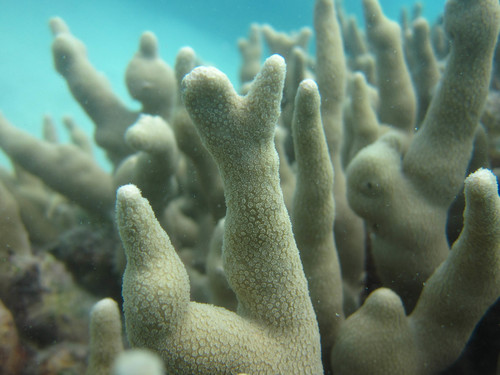
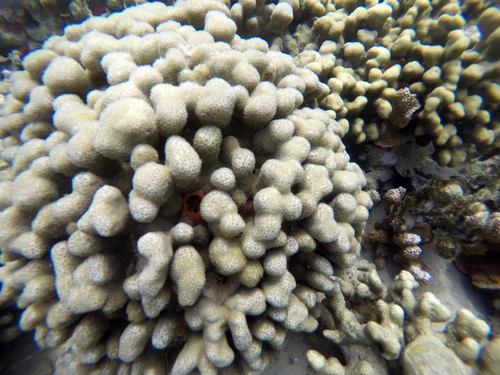
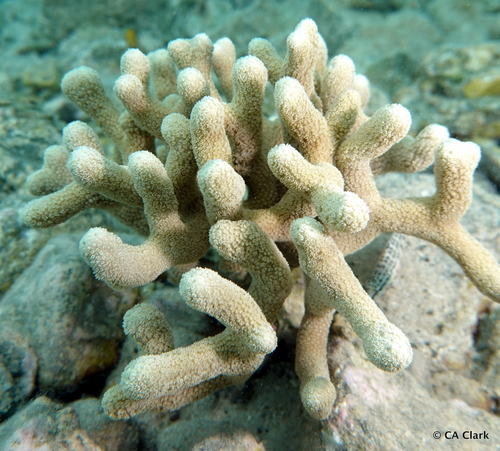
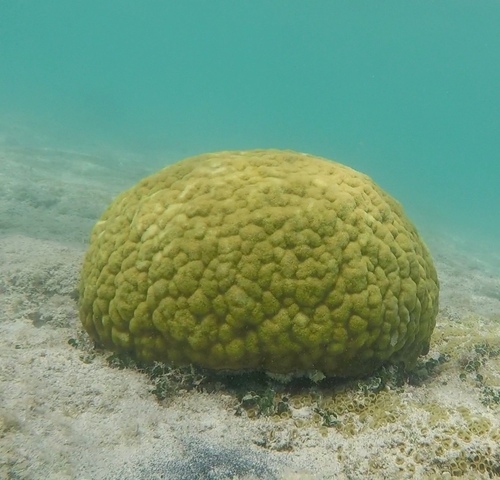
Porites lobata Dana, 1846 is a hermatypic, or reef-building, coral. Its size and shape vary widely based on its environment: it grows as an encrusting form on wave-exposed reef slopes, while in calm water it can develop into large helmet-shaped or hemispherical hummocks reaching up to 6 metres (20 ft) in both height and width. This coral grows very slowly, sometimes adding as little as 1 centimetre (0.39 in) to its size per year, so large individual corals are very old. Its general color is greenish, yellow, or tan, a hue caused by zooxanthellae—symbiotic single-celled microalgae that live within the coral’s tissues. These microalgae produce organic nutrients for the coral’s polyps via photosynthesis. The coral’s corallites are very small and closely packed, joined directly to one another by fused but porous walls. It has diagnostic skeletal features that are only visible under a microscope, and its septa are also fused. The polyps have a diameter of 1 millimetre (0.04 in), and the coenosarc that covers the skeleton is thin. Porites lobata is a common coral species found in tropical regions of the Indian and Pacific Oceans. Its range extends from East Africa, the Red Sea and the Gulf of Aden, through Indonesia and Australian waters, to the Pacific coasts of the Gulf of California and Central America. It is the most common coral species in Hawaii, and is often the dominant species on reef margins, in lagoons, and on fringing reefs at depths down to 30 metres (98 ft). It occurs in a slightly deeper zone than cauliflower coral. Porites lobata is part of the coral reef biome. Several fish species live among the coral’s lobes: some use the structure for shelter, while others, such as the puffer fish Arothron meleagris, graze on the coral’s polyps. The snapping or pistol shrimp Alpheus deuteropus is a commensal that lives among the lobes, where it may form grooves and tunnels.