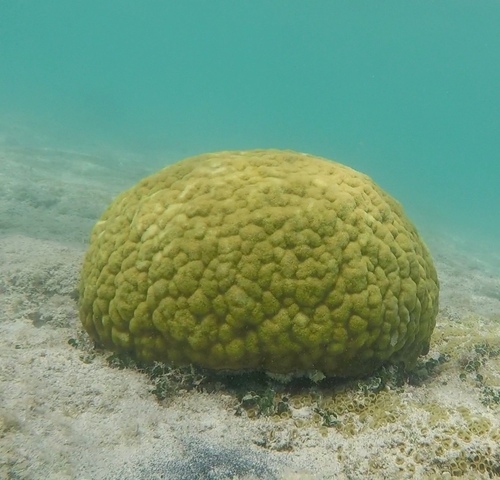
About Porites astreoides Lamarck, 1816
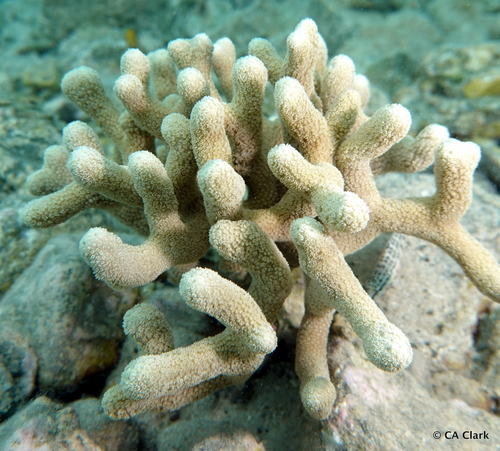
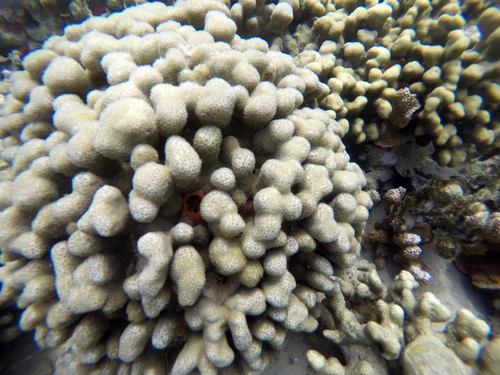
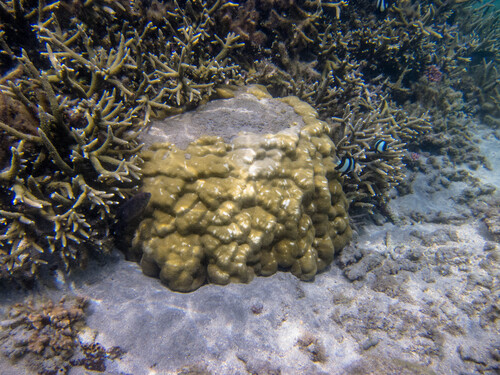
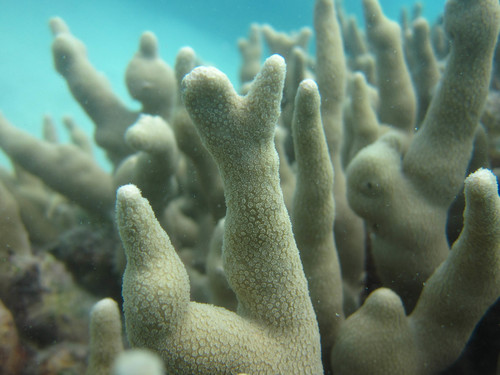
Porites astreoides Lamarck, 1816 has a growth form that changes with its environment. When growing in fast-flowing shallow water, it is encrusting. In calmer medium-depth water, it forms a massive coral with a smooth, mounded, semi-spherical shape that can reach 60 centimetres (24 in) in diameter. At greater depths it is usually plate-like, and in caves and under overhangs these plates grow at an angle to capture the maximum amount of light. It is the only species in the genus Porites that does not have a finger-like form. Its small, tightly-packed corallites give the coral a porous appearance. Each polyp has six tentacles, and polyps are generally retracted during the day. This coral can be yellow, yellowish-green, pale grey, or pale brown; this colour comes from dinoflagellate zooxanthellae, which are microscopic algae that live symbiotically inside the coral's tissue.
Porites astreoides occurs on shallow reefs in the Caribbean Sea, the western-central and southwestern Atlantic Ocean near the Caribbean, as well as in tropical regions of North America, Central America, and South America. It is also found in the eastern-central Atlantic Ocean off tropical western Africa. It is a common species across all parts of reefs and in lagoons. It usually grows in water less than 15 metres (49 ft) deep, but can occasionally be found at depths up to 50 metres (160 ft). It can sometimes be free-living, growing on loose coral fragments, pebbles, or mollusc shells. Large domed colonies sometimes look split into several lobes; this occurs when part of the coral dies, and living tissue between the dead patches continues growing, creating a clumped effect.
Ecologically, Porites astreoides often hosts the sponge Mycale laevis, with its prominent osculi, growing on the coral's underside. It is also frequently associated with fan worms. The coral's polyps have stinging cells called nematocysts that help it fend off predators including stoplight parrotfish, other reef fish, snails, worms, and starfish that feed on it. An unshaded location is important for this coral, so that its symbiotic zooxanthellae can function fully. Sedimentation can interfere with this, but under good conditions, this coral grows at a rate of approximately 3.5 millimetres (0.14 in) per year. The IUCN Red List of Threatened Species classifies Porites astreoides as least concern. It is widespread and common throughout its range. Compared to other species in its genus, it is more resistant to disease and coral bleaching, and it lives in deeper water, so it may be less impacted by rising sea temperatures.