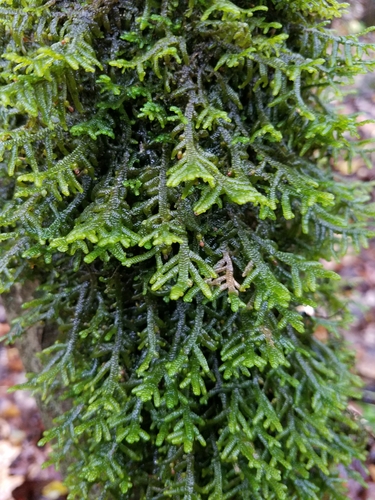
About Porella platyphylla (L.) Pfeiff.
Porella platyphylla (L.) Pfeiff. has several distinctive morphological identification features, though these features vary considerably both within single populations and across different geographical regions. The leaf tips, called lobes, are obtuse-rounded in shape, and their edges lie flat instead of being wavy or folded. Cells in the middle section of these lobes measure 28.5 to 36.1 μm in width. A key identifying trait of this species is located in its perianth, a protective tube-like structure that encloses the developing reproductive organs of female plants. When the perianth is fully mature, its mouth has irregularly spaced teeth that are 2–6 cells wide at their base. The female reproductive structures, called bracts, typically have smooth, unbroken edges, which differs from some related species that may have toothed or spiny margins. Morphological features that were previously used to separate P. platyphylla from Porella platyphylloidea, including leaf lobule width and elater spiral patterns, do not show a consistent correlation with genetic groupings. Even genetically identical populations sometimes displayed different morphological characteristics that were traditionally used to distinguish the two species. More recent molecular studies have identified cryptic species: genetically distinct lineages that cannot be reliably distinguished through morphological examination alone. While some trends do exist, such as larger leaf lobules being more common in North American populations, these characteristics are not consistent enough to allow for reliable identification. This identification challenge is made more difficult by evidence that some populations may be ancient hybrid lineages, which explains the high degree of morphological variability within populations and the unreliability of traditionally used diagnostic features. Porella platyphylla is widely distributed in forest ecosystems that receive at least 600 millimetres of annual precipitation. It is especially abundant in northern and central Europe and along the Atlantic coast and Atlantic islands, though it also occurs scattered throughout Mediterranean regions. This liverwort has a Holarctic distribution, found across Eurasia and North America. Its genetic makeup shows distinct geographical structuring, with European and North American populations forming separate sister clades. Although the species is capable of long-distance dispersal, as its wide distribution demonstrates, molecular evidence suggests that successful establishment and genetic mixing between distant populations remains relatively rare. While the species is widespread across Europe, the typical European form, P. platyphylla sensu stricto, has only been confirmed at one single locality in New Mexico, North America. The species most often grows on tree bark and rocks, though habitat preferences can vary between different genetic lineages. North American populations formerly classified as P. platyphylloidea were historically recorded to occur more often on rock substrates, while European populations were more commonly found growing on bark, but this distinction has proven unreliable for taxonomic classification. In the southern part of the Russian Far East, Porella platyphylla grows primarily on limestone and other basic rocks in partly shaded conditions. However, in northern regions such as the Commander Islands, located around 55°N, it can be found growing on temporarily inundated stream beds, with habitat preferences that match those seen in northern Europe. Within Russia, most of its occurrences fall between 43° and 45°N, though the species extends northward to several locations including Bolshoy Anyuy at 49°N, Komsomolsk Nature Reserve at 51°N, and the Dzhagdy Range at approximately 54°N. Its presence on the Commander Islands, at almost 55°N, appears to be relictual; this is particularly notable because the species is entirely absent from the intervening Kamchatka Peninsula. Porella platyphylla reproduces sexually, with male and female reproductive organs developing on short side branches. The female organs, called archegonia, develop on especially short branches. They consist of a protective jacket of cells that surrounds a central channel holding an egg cell. The male organs, called antheridia, form on slightly longer branches and produce sperm cells. Each antheridium develops on a long, slender stalk made up of two rows of cells. Individual colonies are often multiclonal, with male and female plants growing mixed together, which indicates establishment from multiple separate spores. Female plants are relatively common, making up about 49% of shoots, while male plants are found less frequently, making up around 10% of shoots. After fertilization, the embryo develops into a sporophyte, the spore-producing generation of the species. The mature sporophyte is made up of a capsule that holds spores mixed with elongated cells called elaters, which help to disperse the spores. The base of the sporophyte forms a foot that anchors it to the parent plant, and the shape of this foot ranges from club-like to anchor-shaped.

