About Porcellio scaber Latreille, 1804
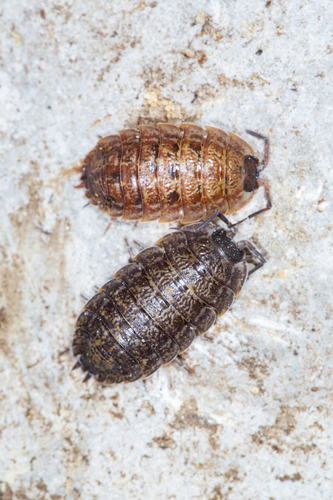
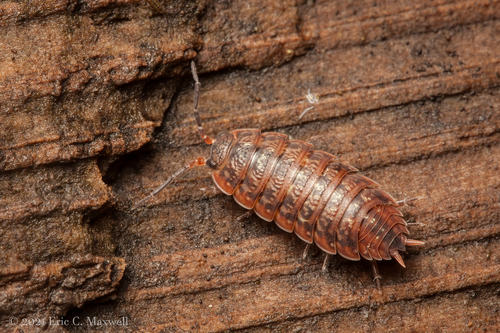
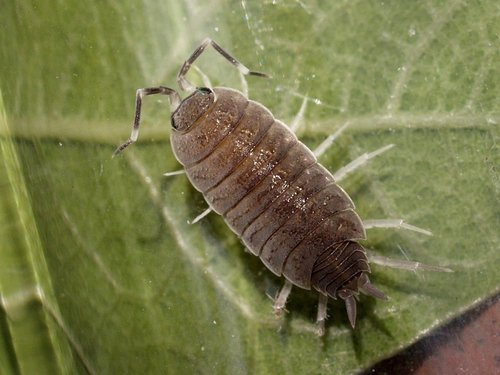
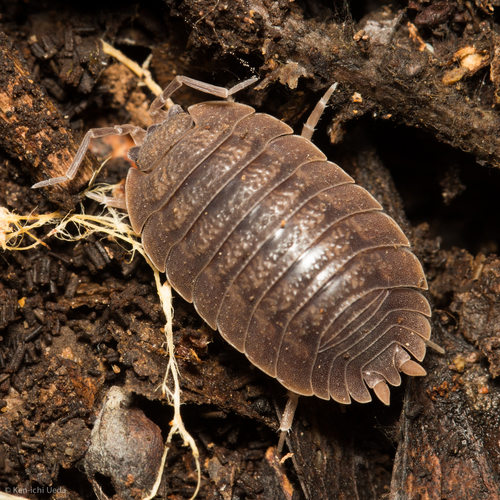
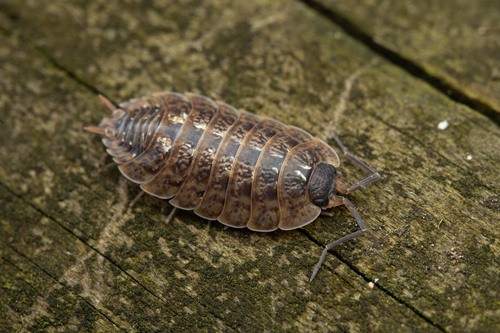
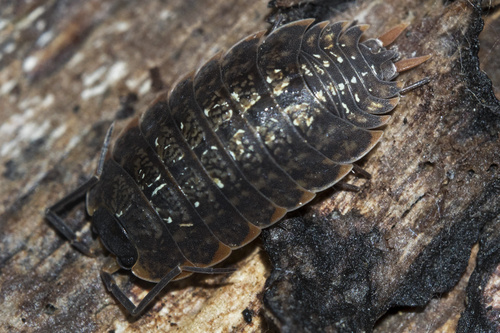
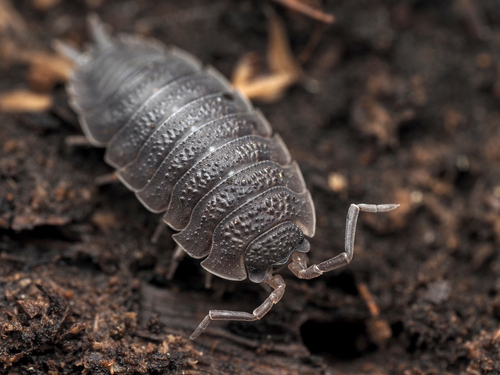
Porcellio scaber has an oval body that can grow up to 20 millimetres (0.79 in) long. Most individuals are grey, with a paler underside. Rare color morphs, which are commonly cultivated in captivity, can also have brown, white, orange, yellow, or purplish coloring along with various patterns. Bright blue individuals have been recorded, but this color is not a natural variation; it is caused by an iridovirus. The segmented upper (dorsal) surface of its exoskeleton is covered in a series of small tubercles, which is the origin of its common name. On its head, it has two pairs of antennae, with the inner pair being very small. Two compound eyes sit on the dorsal side of the head, while the mouthparts are located on the lower (ventral) side. It has 7 pairs of legs, aligned with the 7 segments of its thorax. Its short abdomen is made up of 6 segments. On the ventral side of the abdomen are two whitish pseudo-lungs, which connect to the outside air through pores. At the rear end of the body, there is a small telson flanked by a pair of appendages called uropods.
Porcellio scaber is found across Central and Western Europe. In the United Kingdom, it is one of the "big five" woodlouse species. It has also colonized North America, South Africa, and other regions including the remote sub-Antarctic Marion Island, mostly through human activity. It is also the most common woodlouse species found in Australia.
Because Porcellio scaber loses water through diffusion across its permeable exoskeleton, which lacks a waxy cuticle, it seeks out environments with humid air and plenty of ground moisture to avoid drying out. It prefers these environments to be cold, which slows the rate of water loss, and dark, which helps it avoid detection by predators. It lives in a wide range of damp habitats, and is less dependent on high humidity than the species Oniscus asellus.
In its life cycle, females carry between 25 and 90 fertilized eggs until hatching. The eggs are held in a fluid-filled sac on the ventral side of the abdomen for around 40 to 50 days. Young individuals reach reproductive maturity after 3 months, and adult Porcellio scaber have a life expectancy of roughly two years.