About Porcellana platycheles (Pennant, 1777)
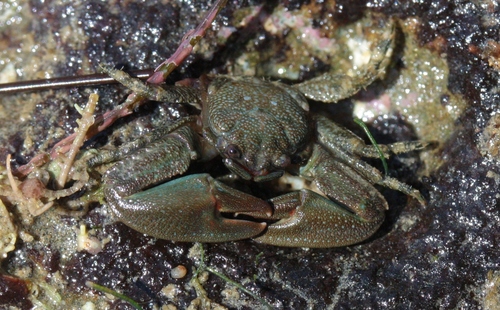
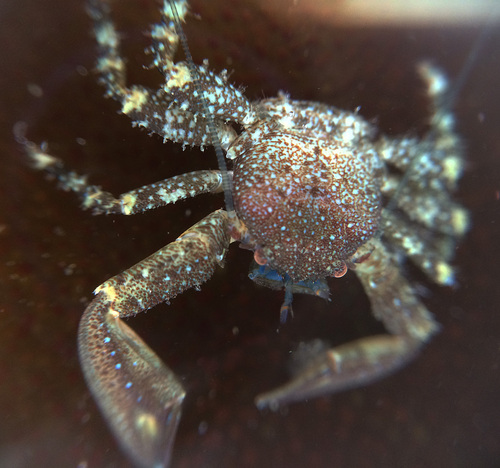
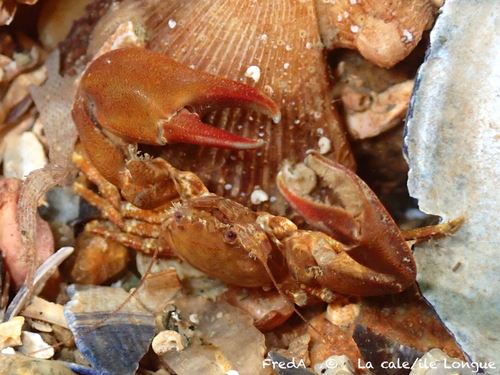
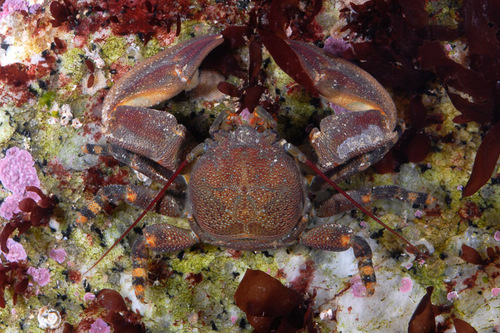
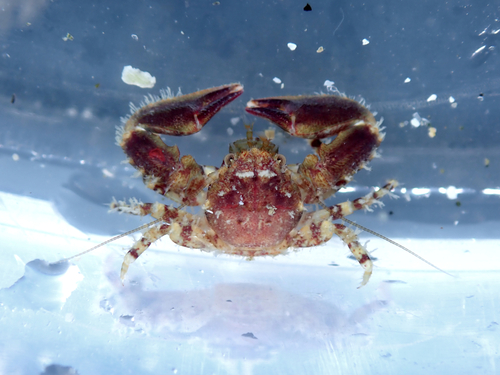
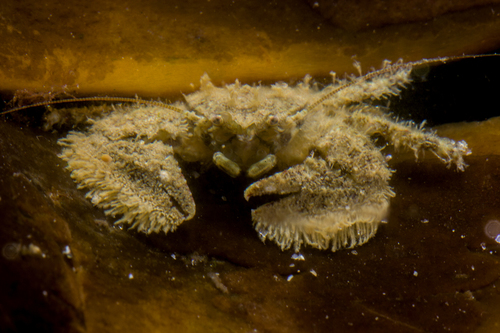
Porcellana platycheles (Pennant, 1777) can grow up to 15 millimetres (0.59 inches) in length. This species has wide, flattened front claws and two long antennae. Its back is greenish-brown, while its belly is off-white. It has a small abdomen that it tucks underneath its carapace. The last pair of its legs is highly reduced and usually hidden, which makes the crab appear to only have three pairs of walking legs. Its body is flattened, and its legs end in sharp claws that the crab uses to grip the undersides of the rocks it lives under. Porcelain crabs like this species are more closely related to lobsters and squat lobsters than they are to "true" crabs; this relationship is suggested by their long antennae. Porcellana platycheles is distributed from Norway to the Canary Islands, and is found throughout the Mediterranean. In Britain, it is widely distributed along all coastlines, from Shetland to the Isles of Scilly. Porcellana platycheles lives beneath rocks and boulders on rocky coasts. It occurs mainly in areas with mud and gravel in the mid to lower intertidal zones, but is occasionally found as deep as the shallow subtidal zone. It is a filter-feeding crab that uses specially adapted hairs on its mouthparts to filter plankton from water; it also feeds on carrion and other organic debris. This crab requires a habitat that contains organic matter, and prefers more sheltered shores, especially locations where organic material has been deposited among rocks.