About Populus tremula L.
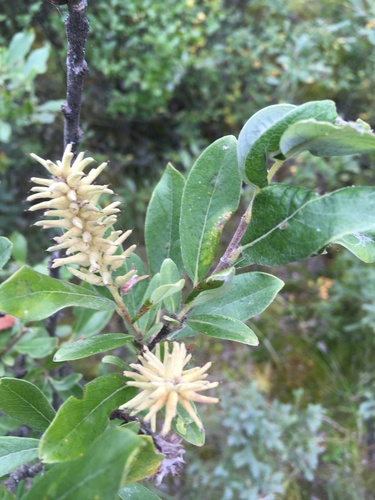
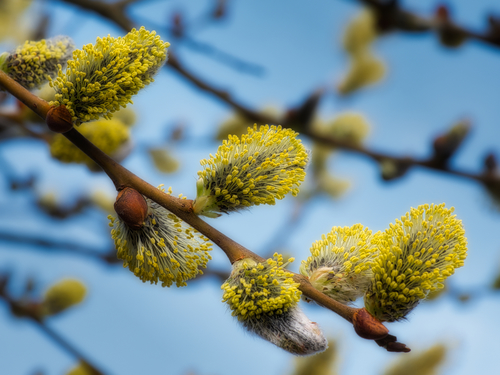
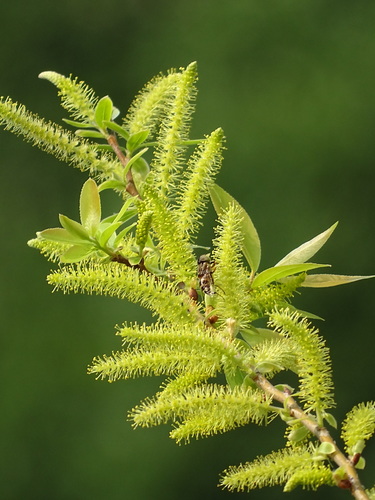
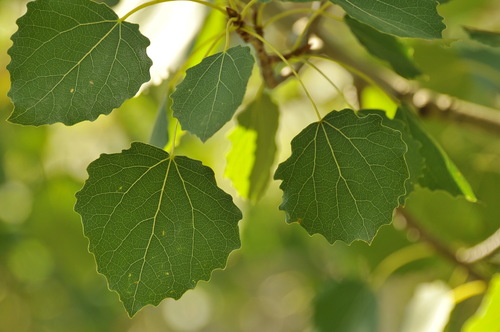
Populus tremula L. is a large deciduous tree that grows to 40 metres (130 ft) tall and 10 m (33 ft) broad, with a trunk that can reach over 1 metre (3 ft 3 in) in diameter. Young trees have pale greenish-grey, smooth bark marked with dark grey diamond-shaped lenticels, while the bark of older trees becomes dark grey and fissured. Mature trees produce adult leaves that are nearly round, slightly wider than long, and 2–8 cm (1–3 in) across. These leaves have coarsely toothed margins and laterally flattened petioles 4–8 cm (2–3 in) long. The flat petiole lets leaves tremble even in light breezes, which is the origin of both its scientific name and the 17th-century vernacular name "langues de femmes" recorded in Gerard's Herball. Leaves on seedlings and fast-growing sucker (root sprout) stems have a different shape, ranging from heart-shaped to nearly triangular, and are often much larger, growing up to 20 centimetres (7.9 in) long; their petioles are also less flattened. Its flowers are wind-pollinated catkins that emerge in early spring before new leaves appear, and the species is dioecious, meaning male and female catkins grow on separate trees. Pollen-shedding male catkins are green and brown, and measure 5–10 centimetres (2.0–3.9 in) long. Female catkins are green, 2–6 centimetres (0.79–2.36 in) long at pollination, and mature in early summer to bear 10–20 (up to 50–80) capsules. Each capsule holds many tiny seeds embedded in downy fluff that helps wind dispersal when the capsules split open at maturity. It can be told apart from the closely related, nearly identical North American Populus tremuloides by its more coarsely toothed leaves. Like other aspens, Populus tremula spreads widely through suckers (root sprouts), which can grow up to 40 m from the parent tree and form large clonal colonies. This often makes removing unwanted trees very difficult, as new suckers will keep sprouting from the extensive root system for several years after all above-ground growth is removed. The species is native to Europe and Asia, ranging from Iceland and the British Isles east to Kamchatka, north to inside the Arctic Circle in Scandinavia and northern Russia, and south to central Spain, Turkey, the Tian Shan, North Korea, and northern Japan. It also grows at a single site in northwest Africa, Algeria. In the southern part of its range, it occurs at high altitudes in mountains. Eurasian aspen requires large amounts of water and light, and can vigorously colonize open areas after fire, clear cutting, or other types of damage. If an individual tree is damaged or destroyed, abundant root suckers grow from shallow lateral roots. Growth is fast until around 20 years of age, when crown competition increases. After this point, growth speed slows, and growth culminates at around 30 years of age. Aspen can live up to 200 years. It is a very hardy species that tolerates long, cold winters and short summers. Its unpleasant taste makes it resistant to browsing by fallow deer. It acts as a host for hornet moth larvae, making it important to this species. Populus tremula is cultivated in parks and large gardens. The fastigiate cultivar 'Erecta', which has bright yellow autumn foliage, has earned the Royal Horticultural Society's Award of Garden Merit. This cultivar is commonly called "Swedish columnar" in Canada and the United States. Its hybrid with Populus alba (white poplar) is known as grey poplar, Populus × canescens, which is widespread across Europe and central Asia. Hybrids with several other aspens have also been bred at forestry research institutes to develop trees with higher timber production and greater disease resistance, for example P. tremula × P. tremuloides bred in Denmark. The wood of aspen is light and soft with very little shrinkage. It is used for lumber and matches, and is also valued in the pulp and paper industry, being especially useful for writing paper. It is also used to make plywood and different types of flake and particle board. Thanks to its hardiness, rapid growth, and strong regeneration capacity, it plays an important role in producing wood for renewable energy. Ecologically, the species supports many species of insects and fungi, and provides habitat for multiple mammals and birds that depend on young forests.