About Populus grandidentata Michx.
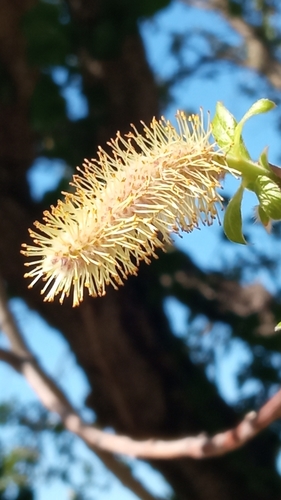
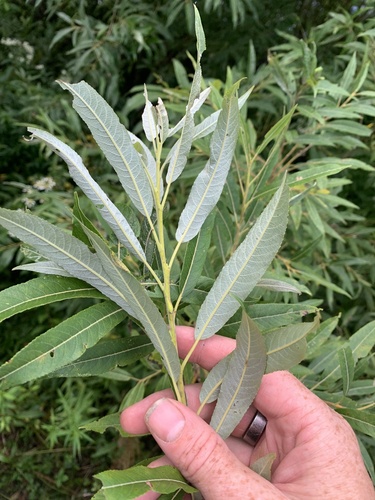
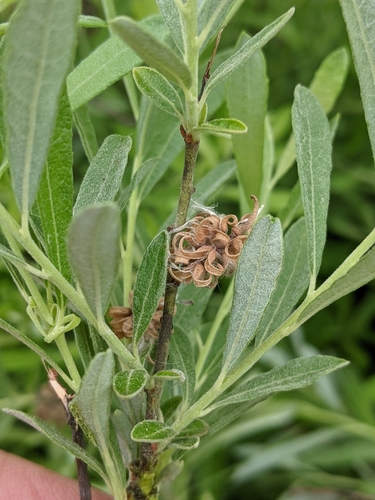
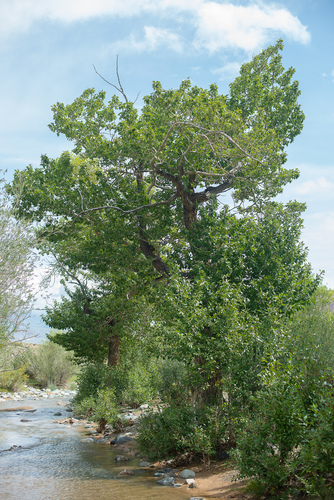
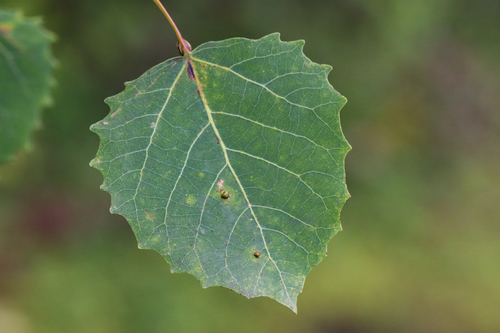
Populus grandidentata Michx. is a medium-sized deciduous tree native to North America, found mostly in the northeastern United States and southeastern Canada. Its leaves are similar to those of Populus tremuloides, but are slightly larger and have larger teeth, and they tremble in the wind just like P. tremuloides leaves do. Young trees have olive-green, thin, smooth bark; after 30 to 40 years, the bark becomes gray, thick, and rough with grooves. The species' range extends from Virginia north to Maine and Cape Breton Island, Nova Scotia; west to southeastern Manitoba and Minnesota; south through Iowa to extreme northeastern Missouri; and east through Illinois, Indiana, Ohio, and West Virginia. Disjunct populations occur in Kentucky, Tennessee, North Carolina, and South Carolina. Bigtooth aspens produce seeds from wind-pollinated flower clusters called catkins. The species is dioecious, meaning male and female flowers grow on separate trees, and flowering takes place from mid-April to mid-May depending on climate zone. Seeds are held in two-valved capsules and widely distributed by wind. Seed production begins around 10 years of age. Trees can also reproduce through roots after disturbance events such as fire or harvest; roots of dead or cut trees send up suckers that grow into genetically identical individuals, and this can produce a stand of clones matching the original tree. Seed viability is high at around 80%, and a mature tree can produce over 1 million seeds per season, but very few seeds actually germinate. This is because seeds have a short two-week viability, contain a natural growth inhibitor, and often land in spots unsuitable for germination, which must occur on the surface of moist soil. The species can adapt to a wide range of soils, but is most abundant on sands, loamy sands, and light sandy loams. It can tolerate sandy uplands and high, rocky sites, where the depth to the water table is generally about 5 feet (1.5 m). Soil must be moist but well-aerated for good growth. It is very shade intolerant, and most shaded stems die. It acts as a pioneer species on disturbed sites, persisting in successional communities until senescence. Rapid height growth of suckers allows it to outcompete other sprouting species such as red oak (Quercus rubra) and red maple (Acer rubrum) on many sites. In the absence of disturbance, it is soon replaced by conifers and hardwoods. In the Great Lakes Region at the turn of the 20th century, many mature pine forests were logged and burned, and bigtooth and quaking aspens frequently dominated the resulting post-disturbance forests. Without fire or other disturbance, these forests are now being replaced by later successional, shade-tolerant species. This aspen usually grows in even-aged, mixed stands, most commonly with quaking aspens. It is codominant in both hardwood and coniferous forests, and does not occur as a subdominant due to its extreme shade intolerance. Quaking aspen (Populus tremuloides) is the predominant aspen species in Great Lakes region aspen stands, but bigtooth aspen dominates on drier, upland sites. Aspen stands dominated by bigtooth aspens are generally more open than those dominated by quaking aspens. It is more disease resistant than P. tremuloides. The most serious disease affecting it is hypoxylon canker, caused by Entoleuca mammata. Other rots, fungi, and root decay also impact the species. It is a preferred host of the gypsy moth, and tree death occurs when near-complete defoliation by gypsy moths is followed by an infestation of Armillaria fungus. The ambrosia beetle (Xyleborus saxesceni) attacks fire-damaged bigtooth aspens. The species commonly occurs in areas that burn frequently, such as large upland areas distant from water and upwind of natural fire breaks like lakes. Various types of wildlife feed on the bark, foliage, and twig buds of this tree. Its wood weighs 27 pounds per cubic foot (12 kg per cubic foot), is light-colored, straight-grained, fine-textured, and soft. It is used primarily for pulp, but can also be used to make particle board and structural panels. Minor uses include log homes, pallets, boxes, match splints, chopsticks, hockey stick components, and ladders. The bark is pelletized for fuel and as supplemental cattle feed. This species is occasionally cultivated, and a new cultivar called Grandmont has recently been developed. It has an open growth habit with balanced branching.