About Populus fremontii S.Watson
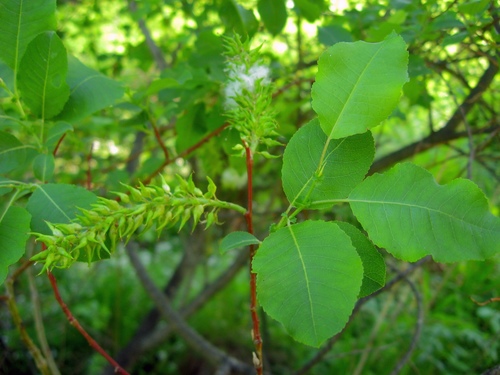
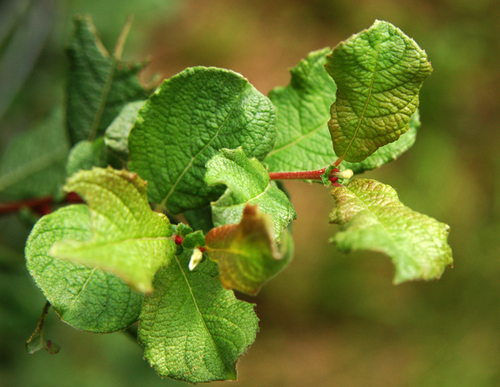
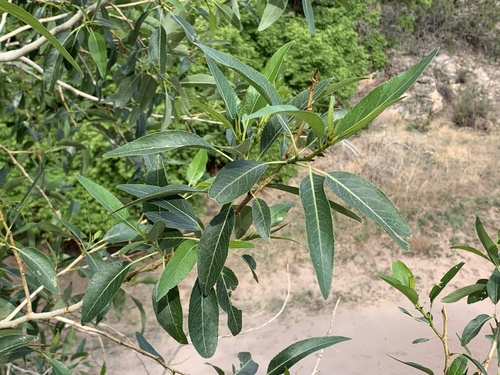
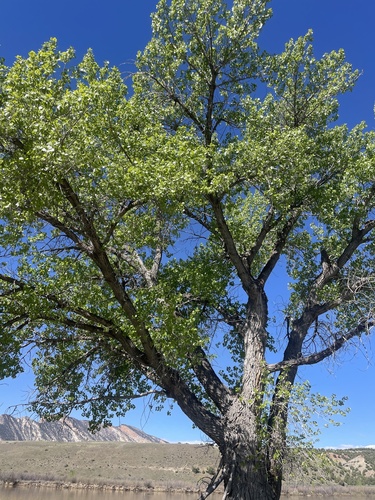
Populus fremontii S.Watson, commonly called Frémont's cottonwood, is a large tree that reaches 12–35 m (39–115 ft) in height, with a wide crown and a trunk up to 1.5 m (4 ft 11 in) in diameter. Its bark is smooth on young trees, and becomes deeply fissured, whitish, and cracked on mature old trees. Its leaves are 3–7 cm (1.2–2.8 in) long, heart-shaped (cordate) with an elongated tip. The leaves have white veins, coarse crenate teeth along their edges, range from hairless to hairy, and are often stained with milky resin. In autumn, from October to November, its foliage turns mainly bright yellow, sometimes orange, and rarely red. Its inflorescence is a long, drooping catkin that blooms from March to April. Its fruit is a wind-dispersed achene that forms cotton-like patches hanging from tree limbs, which gives the species its common name of cottonwood. The largest known Populus fremontii in the United States grows in Skull Valley, Arizona; in 2012, it was measured to have a circumference of 557 in (14,100 mm), a height of 102 ft (31 m), and a spread of 149.5 ft (45.6 m). This tree is native to the Southwestern United States and Mexico. In the United States, it occurs in California, Idaho, Nevada, Utah, Arizona, New Mexico, Texas, and Colorado. In Mexico, it occurs in Baja California, Baja California Sur, Sonora, Chihuahua, Coahuila, Nuevo León, México state, and Puebla. It is a riparian tree that grows near streams, rivers, springs, seeps, and wetlands, as well as on well-watered alluvial bottomlands, at elevations below 2,000 metres (6,600 ft). Populus fremontii is cultivated as an ornamental tree and for riparian zone restoration. It is planted to provide wildlife food and shelter habitat, for ecological restoration projects, in larger native plant gardens, wildlife gardens, and natural landscaping projects, as well as for windbreaks, erosion control, and shade for recreation facilities, parks, and livestock. In the past, settlers and ranchers used Frémont's cottonwood for fuel and fence posts.