About Populus deltoides W.Bartram ex Marshall
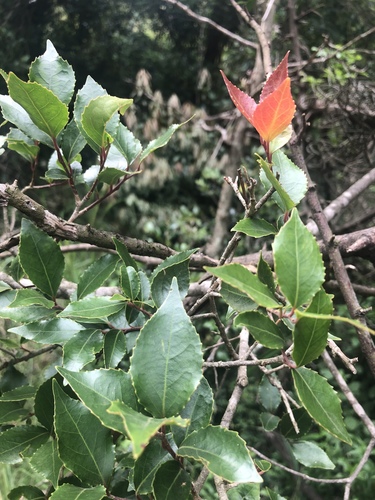
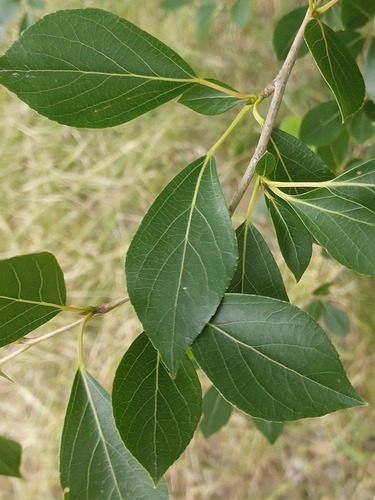
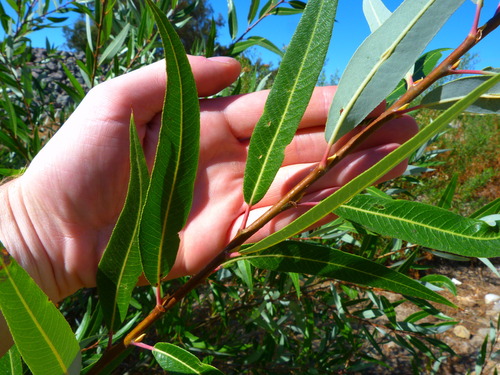
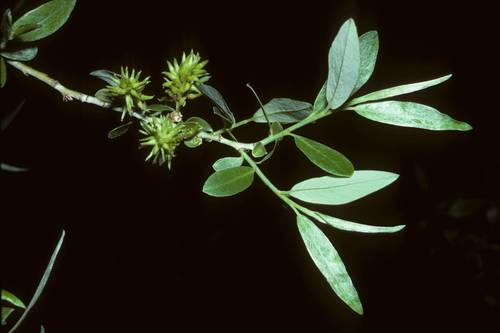
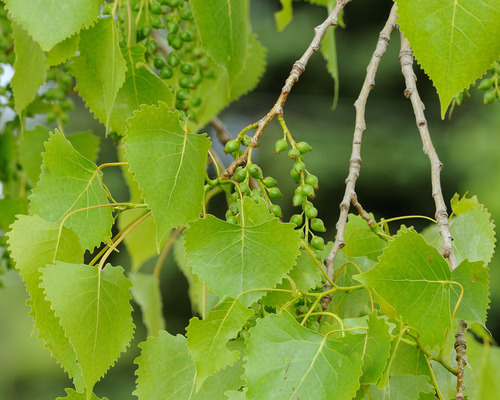
Populus deltoides W.Bartram ex Marshall, commonly called eastern cottonwood, is a large hardwood tree native to North America, and one of the largest North American hardwood trees. It typically reaches 20–30 m (65–100 ft) in height, with a trunk that can grow up to 2.8 m (9 ft 2 in) in diameter. Young trees have silvery-white bark that is smooth or lightly fissured, while bark on older trees becomes dark gray and deeply fissured. Twigs are stout, grayish-yellow, and marked by large triangular leaf scars. Winter buds are slender, pointed, 1–2 cm (1⁄2–3⁄4 in) long, yellowish brown, and resinous. This species is one of the fastest growing trees in North America. In Mississippi River bottoms, young trees have been recorded growing 3–5 m (10–15 ft) in height per year for the first few years. Sustained annual growth of 1.5 meters (5 ft) in height and 2.5 centimeters (1 in) in diameter is common for up to 25 years. Its leaves are large and deltoid (triangular), measuring 4–10 cm (1+1⁄2–4 in) long and 4–11 cm (1+1⁄2–4+1⁄4 in) broad, with a truncated (flattened) base and a 3–12 cm (1+1⁄4–4+3⁄4 in) long flat petiole. The leaf margin is very coarsely toothed, with curved, gland-tipped teeth. Leaves are dark green in summer and turn yellow in fall, though many cottonwoods growing in dry locations drop their leaves early due to a combination of drought and leaf rust, resulting in dull or absent fall color. The flat petiole makes leaves shake even in the lightest breeze, which is one of this species' identifying characteristics. Eastern cottonwood is dioecious: all flowers (called catkins) grow on single-sex trees, and emerge in early spring. Male pollen-producing catkins are reddish-purple and 8–10 cm (3+1⁄4–4 in) long. Female catkins are green, measuring 7–13 cm (2+3⁄4–5 in) long at pollination, and mature to 15–20 cm (6–7+3⁄4 in) long by early summer. They bear multiple 6-to-15-millimeter (1⁄4-to-9⁄16-inch) seed samara capsules that split open to release many small seeds attached to cotton-like strands. A single tree can release up to 40 million seeds per season. The native range of eastern cottonwood is very large, extending from southwestern Mexico north into southern Canada, and from New Hampshire west to Oregon. In Mexico, the species occurs mainly as subspecies wislizeni; it is native only to southwestern Jalisco, grows only in Sonora in the northwest, is found across roughly half of the states in northeastern Mexico (including Aguascalientes, Coahuila, Chihuahua, Durango, Nuevo León, and Zacatecas), and is also present in the Gulf Coast state of Veracruz. In the southwestern United States, the USDA Natural Resources Conservation Service (NRCS) records the species as native as far west as scattered locations in Utah and Arizona, and it is fairly widespread across New Mexico and Texas. In the Pacific Northwest, Plants of the World Online (POWO) lists eastern cottonwood as native to Washington, Oregon, and Idaho, while NRCS only records it as native east to Montana, Wyoming, and Colorado. Further east, the species is native to every central and southeastern U.S. state, including northern Gulf Coast regions of Florida. NRCS records it as native to every U.S. northeastern state, while POWO does not list it as present in Maine or Rhode Island. In Canada, eastern cottonwood grows along the southernmost edge of Quebec, in southern Ontario (mainly near Lake Ontario and Lake Erie), and is widespread across southern Alberta, Saskatchewan, and Manitoba. Both NRCS and POWO also report it as native to British Columbia. For successful germination and establishment, eastern cottonwood requires bare soil and full sun. In natural conditions, it most often grows near rivers, where flood-deposited mud banks provide ideal conditions for seedling germination. Human soil cultivation has allowed the species to expand its range away from these riverine habitats. Unlike related species such as quaking aspen, eastern cottonwood does not propagate via clonal colonies, but it resprouts readily after being cut down. Its leaves are eaten as food by caterpillars of many different Lepidoptera species. The wood of eastern cottonwood is soft, as is typical for the Populus genus, with a density of just 0.45 g/cm3 (28 pounds per cubic foot). It is used to make products such as plywood and the interior parts of furniture. During the 1868–1869 winter campaign against Native American tribes south of the Arkansas River, General Custer fed the tree's bark to his horses and mules. According to cattleman Charles Goodnight, cowboys with gastric disorders made an astringent tea from the tree's inner bark.