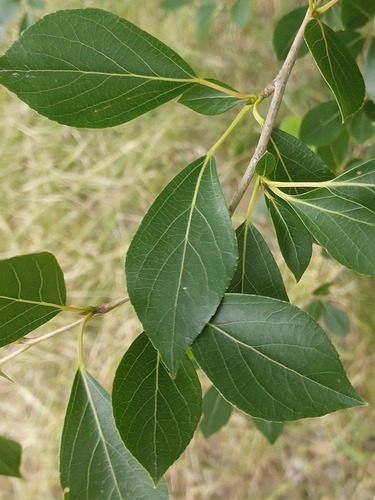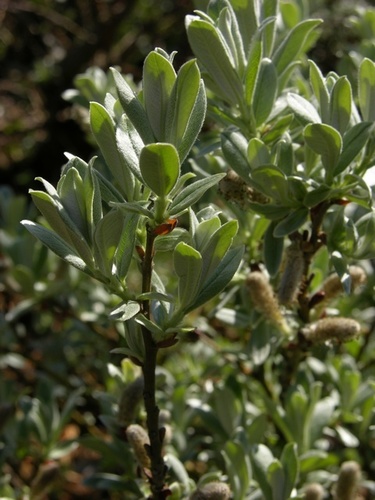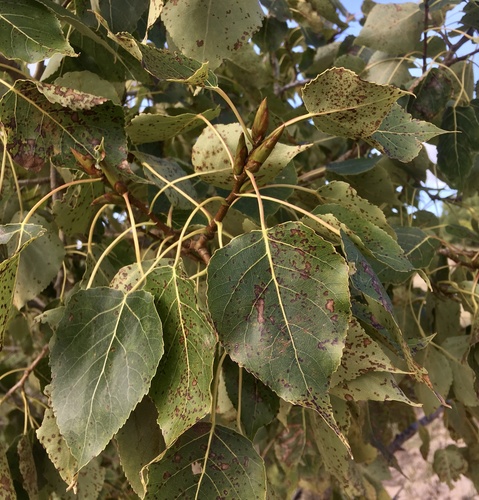
About Populus balsamifera L.
Populus balsamifera L., commonly known as balsam poplar, bam, bamtree, eastern balsam-poplar, hackmatack, tacamahac poplar, and tacamahaca, is a tree species belonging to the balsam poplar species group of the poplar genus Populus. The genus name Populus comes from the Latin word for poplar, while the specific epithet balsamifera means "balsam-bearing" in Latin. Populus balsamifera is the northernmost North American hardwood. It grows transcontinentally across boreal and montane upland and floodplain sites, and reaches its best growth on flood plains. It is a hardy, fast-growing tree that is typically short-lived, though some individual trees have been found to be as old as 200 years. The species is known for the strong, sweet fragrance released from its sticky, resinous buds; the scent is often compared to that of balsam fir. Balsam poplar has a native range covering northern North America and far eastern Russia. In Russia, it is recorded as native in the World Geographical Scheme for Recording Plant Distributions basic recording unit of Magadan Oblast, which includes Chukotka Autonomous Okrug. In Alaska and Canada, its range forms a continuous belt stretching from Alaska across Canada to Newfoundland. Large portions of this belt lie in Yukon and the Northwest Territories in the far north, with an edge extending into western Nunavut. In Western Canada, it grows widely across Alberta, Saskatchewan, and Manitoba, and only extends into eastern and northern parts of British Columbia. In eastern Canada, it grows across almost all of Ontario, the southern half of Québec, southern Labrador, and all of the Maritime provinces and Newfoundland. Parts of balsam poplar's continuous range extend south into the United States. It grows across the northern half of Minnesota, northern Wisconsin, almost all of Michigan, parts of upstate New York, Vermont, northern New Hampshire, and most of Maine. In the Western United States, it also grows in isolated areas of Montana, the Dakotas, Wyoming, and Colorado. In the Midwest, it is also found in Iowa, Illinois, Indiana, Kentucky, and Ohio. In the eastern United States, native pockets of balsam poplar grow in Massachusetts, Connecticut, Pennsylvania, and West Virginia. Trees growing in Maryland are thought to be introduced. The light, soft wood of Populus balsamifera is used to make pulp. The resinous sap (the tree's balsam) comes from its buds, and is sometimes used by bees as a hive disinfectant. Spring windstorms often blow branches with resinous buds to the ground, and herbalists from many cultures collect these to make medicine. The sticky spring buds are a highly valued ingredient in medicinal salves and other herbal preparations in both Indigenous North American and European herbal traditions. Many types of animals use the twigs of Populus balsamifera for food. The tree's leaves also serve as food for caterpillars of various Lepidoptera.