About Populus alba L.
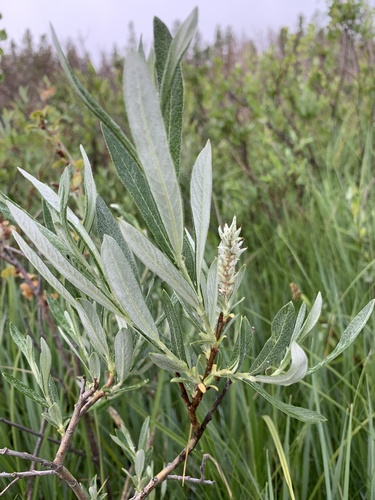
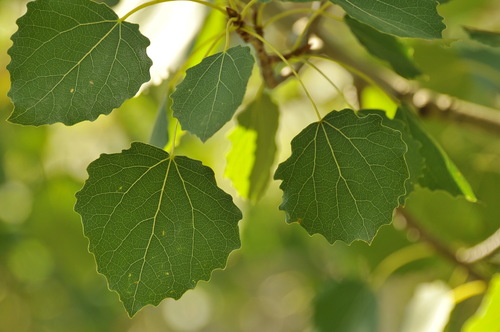
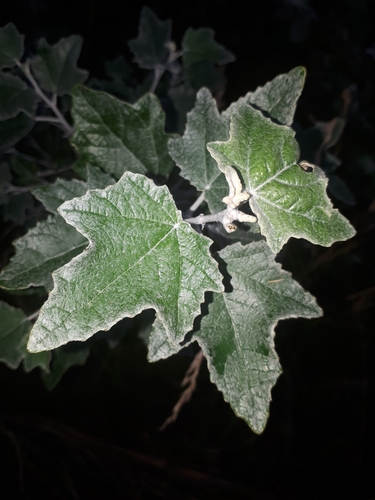
Populus alba L. is a medium-sized deciduous tree that grows 15 to 30 meters tall (rarely taller), with a trunk that can reach up to 2 meters in diameter and a broad, rounded crown. The bark is smooth and ranges from greenish-white to greyish-white, with characteristic diamond-shaped dark markings on young trees; on old trees, the bark at the base becomes blackish and fissured. Young shoots, including small buds, are covered with whitish-grey down. Leaves are 4 to 15 centimeters long, five-lobed, and have a thick layer of white scurfy down on both sides, with a thicker layer on the underside. Catkins, which are 8 centimeters long, are produced in early spring. This species is dioecious, meaning male and female catkins grow on separate individual trees. Male catkins are grey with conspicuous dark red stamens, while female catkins are greyish-green. After pollination, female catkins lengthen to 8 to 10 centimeters and bear several green seed capsules that mature from late spring to early summer. Populus alba L. can also propagate via root suckers that grow from its lateral roots, often 20 to 30 meters from the original trunk, forming extensive clonal colonies. The wood of Populus alba L. is soft, close-grained, easy to carve, and shrinks very little during seasoning. It has been used for sculpture across Europe, China, and the United States; Donatello's 15th-century Penitent Magdalene is one notable example. Throughout the Middle Ages and Renaissance in Italy, it was the most common wood used for panel paintings, and it remained the dominant painting support until it was mostly replaced by canvas after 1500. Most early Italian Renaissance paintings, including the Mona Lisa, are painted on poplar panels. White poplar needs abundant light and ample moisture, and tolerates flood water and slightly acidic soils well. Its contrasting green-and-white leaves make it a popular ornamental tree, though its root suckers can cause problems in some settings. It grows very attractively as an open-grown tree in water meadows, and due to its extensive root system and salt tolerance, it is also planted to stabilize coastal sand dunes. A yellow dye can be produced from the bark of white poplar. Most cultivated white poplars in northern Europe are female trees.