About Poodytes punctatus (Quoy & Gaimard, 1832)
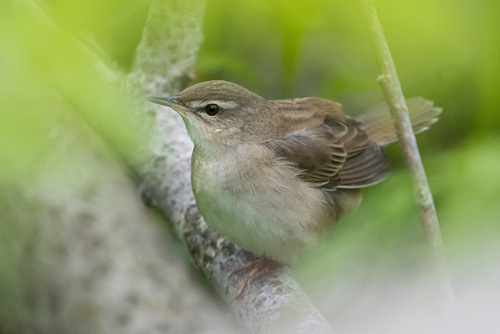
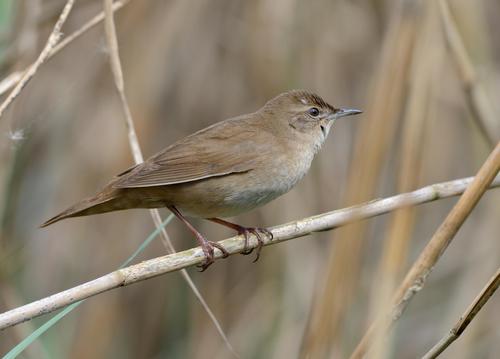
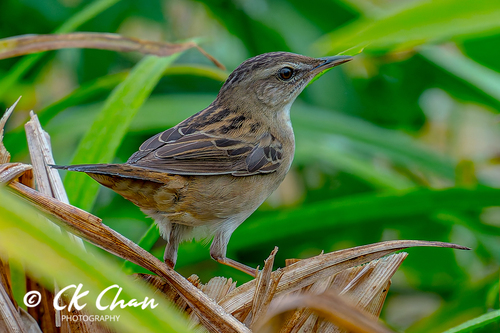
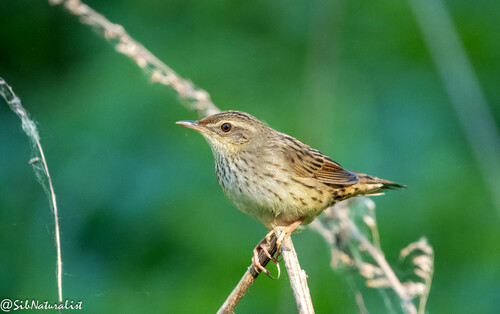
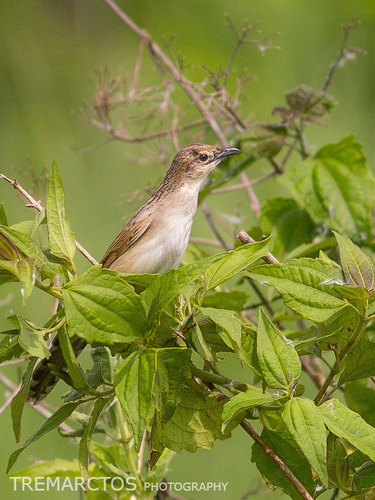
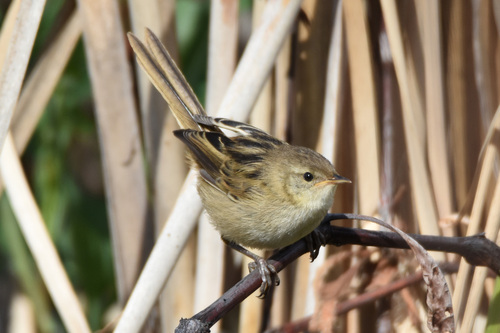
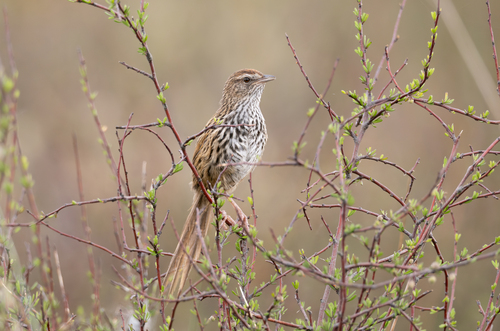
Adult Poodytes punctatus, the New Zealand fernbird, have brown plumage streaked with black. The head, upperparts, and brown wings are all streaked blackish. Its long graduated tail is a duller shade of brown, with darker rectrices. On the underparts, the chin, throat, breast, and abdomen are whitish and finely mottled, with additional blackish streaks concentrated on the breast. The flanks, sides of the chest, and subcaudal coverts are brown and streaked blackish, with clearer streaking on the flanks.
On the head, the forehead and cap are brown. A whitish eyebrow may be present, and it can range from more distinct to faint. The auricular coverts are grey-brown with fine darker streaks that blend into the brown of the upperparts along the sides of the neck. The beak is blackish, with a grayer lower mandible. Eyes are dark brown, while legs and toes are pinkish-brown. Both sexes are similar in appearance, and juveniles also resemble adults.
Overall, the New Zealand fernbird is rich brown on its upperparts and white on its underparts, with brown spots on both the throat and breast. Early European settlers called this species the "swamp sparrow", most likely due to its coloration. Its tail feathers are thin, dark brown, and spine-like. The full body length from beak tip to tail end is 18 cm (7 in), and almost half of this total length is made up by the tail.
The New Zealand fernbird is a reluctant flier. It mostly moves through dense vegetation, and only takes occasional short flights of less than 15 meters that stay just above the vegetation. In the 19th century, Walter Buller described it as "one of our most common" New Zealand birds. However, after European settlement, widespread destruction of the species' natural wetland habitat harmed its populations, and it is now rare.
This bird lives mainly in wet shrubby environments, including swamps, peat bogs, ponds, plantation areas, and temperate shrublands. Its total extent of occurrence is an extremely wide 657,000 km². Field studies of South Island fernbirds found the species prefers shrubby habitats with low dense ground vegetation located near estuary margins.
The New Zealand fernbird is insectivorous. It feeds on caterpillars, insect larvae, beetles, flies, and moths, as well as small spiders that have just emerged from their cocoons. It will sometimes also consume seeds and fruits.
Its song is a series of rapid whistles and clicks. Mated pairs perform a characteristic duet to maintain contact: the male gives a sonorous "uu", and the female responds with a high-pitched "tick", making the characteristic duet call "u-tick". Its calls are metallic. When disturbed or threatened, the male produces a typical "too-lit" followed by rapidly repeated "di,di,di,di".