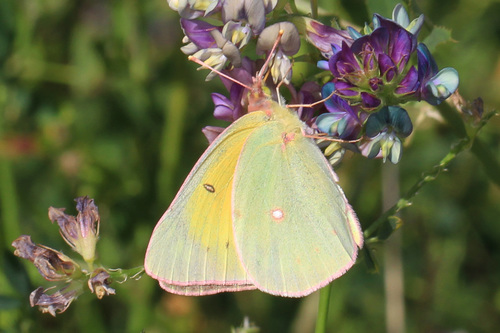
About Pontia edusa (Fabricius, 1777)
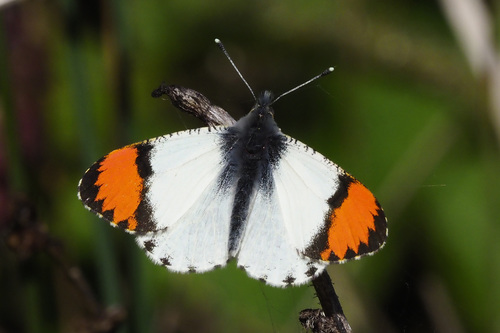
Pontia edusa, described by Fabricius in 1777, is a small to medium-sized migratory butterfly, with a wingspan that reaches around 45 mm. The upperside of its wings is white, with black markings at the apex of both the forewings and hindwings. The undersides of the hindwings bear greenish-grey spots. This species is almost indistinguishable from Pontia daplidice, which makes determining the western boundary of its range very challenging. Examination of genitalia and DNA analysis are the only reliable methods to tell these two species apart. Adult Pontia edusa fly from March to October, producing two to four generations per year depending on latitude. Eggs are laid singly and hatch after an incubation period of seven days. Caterpillars can be found starting in May. They are greyish-green with black spots and broad yellow stripes, and look very similar to the larvae of the cabbage butterfly Pieris brassicae. The larvae feed on plants in the Resedaceae family. Pontia edusa overwinters in the chrysalis stage. This butterfly occurs from southeastern Europe, including southern France, Italy, Corsica, and Sardinia, extending north into central Europe and east through the Middle East to Iran and Iraq. As a migrant species, it can also be found in Belgium, the Netherlands, northern Germany, Poland, the Baltic states, and southern Sweden and Norway. Pontia edusa inhabits any open grassy or flowery areas, stony or rocky sites, and roadsides. It is typically found at altitudes up to 1,500 metres (4,900 ft), and can occasionally occur at higher elevations. It is especially common in areas where its host plants grow, across an altitude range of 0 to 2,300 metres (0 to 7,546 ft).