About Pontia daplidice (Linnaeus, 1758)
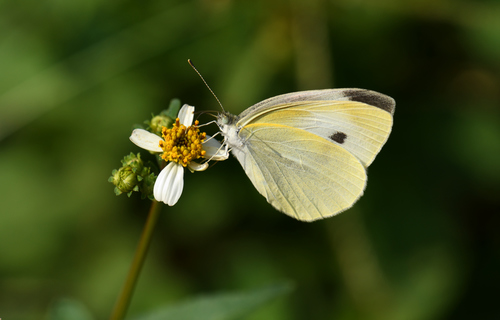
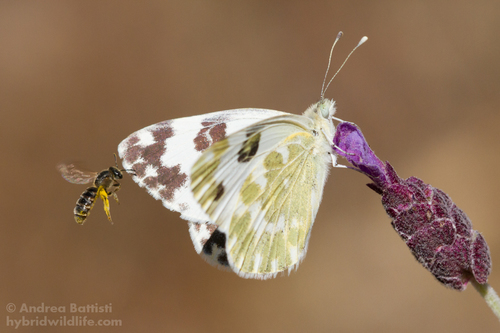
Pontia daplidice, commonly known as the Bath white, is a small white butterfly with a typical wingspan of 45 to 50 mm, with measurements of 52–56 mm recorded in the source description sourced from C. T. Bingham's 1907 work The Fauna of British India, Including Ceylon and Burma, "Butterflies Volume 2". A characteristic greenish blotch pattern on the underside of the hindwing distinguishes this species from other pierids. The two sexes can be told apart by their forewing markings, specifically markings on the upperside of the forewing. The forewing apex is black with white spots and lines, and there is a black spot at the end of the cell; females have an additional discal spot in 1b, plus an obscure row of terminal and marginal spots on the upper hindwing.
Detailed male description: Upperside is white. On the forewing, the basal half of the costa is narrowly irrorated with black scales, with a broad irregular quadrate black spot over the discocellulars; the apex and anterior termen above vein 3 are broadly black, with a subterminal series of spots in the ground colour, extended as fine lines to the terminal margin. The hindwing is uniform, with underside markings showing faintly through; there is a costal spot before the apex, and in some specimens some obscure anterior terminal markings indicated by irrorated black scaling. Underside is white. On the forewing, the marking shape matches that on the upperside, but the base of the cell has an irroration of green scales, the black discocellular spot extends to the costa, is often washed with green or has a green centre in the black; the apical patch is green rather than black, with the ground colour spots on it ill-defined and obscure; there is a black or greenish-black spot in the outer half of interspace 1. The hindwing is green; the costal margin at the base is yellow, the dorsal margin is white; there is a spot in the middle of the cell, another above it in interspace 7, a curved irregular discal series of conjoined spots beyond the cell, with the upper two spots in interspaces 1 to 6 white; the veins are sometimes faintly yellow. Antennae are dusky-black; head, thorax and abdomen are fuscous black above, and white beneath the body.
Detailed female description: Upperside differs from the male as follows: On the forewing, a dusky-black streak extends from the base along the costa and ends at the black spot on the discocellulars; there is a transverse, somewhat quadrate black spot in the outer half of interspace 1, sometimes with a short ill-defined black streak below it; the black area on the apex and anterior portion of the termen is broader, with the white spots on it blurred and obscure. On the hindwing, there is a large costal black spot before the apex; a broad, black, subterminal, inwardly diffuse, curved band that continues from the spot, and a terminal series of clavate black marks starting from the outer margin of the black subterminal band. Underside markings are much like the male's but broader. Antennae, head, thorax and abdomen match the male.
This butterfly is common in central and southern Europe, Asia Minor, Persia and Afghanistan, and migrates northwards during the summer. In Central Asia, its range extends from Baluchistan, Peshawar, Chitral, and Kashmir along the Himalayas all the way across the Central Himalayas to Darjeeling, and the species appears to be extending its range westwards along the Himalayas. It typically inhabits dry slopes and rough ground with little vegetation, and can also be found in Mediterranean coastal dunes and rocky, hot slopes.