About Pontederia crassipes Mart.
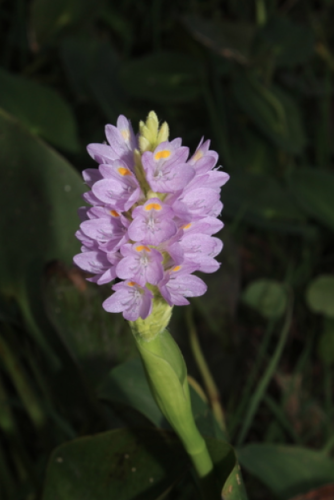
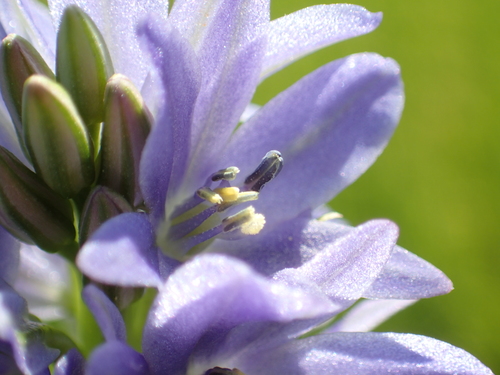
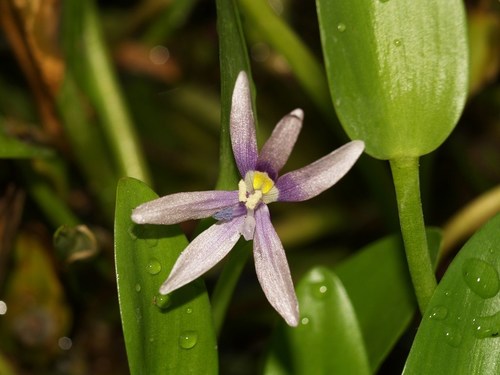
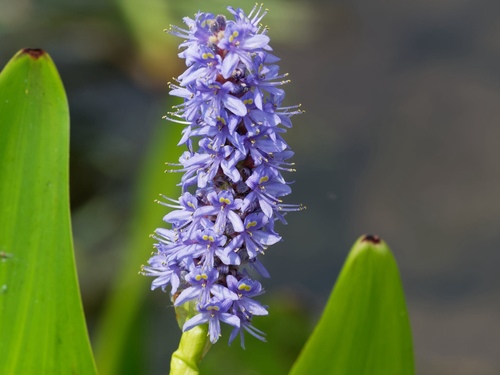
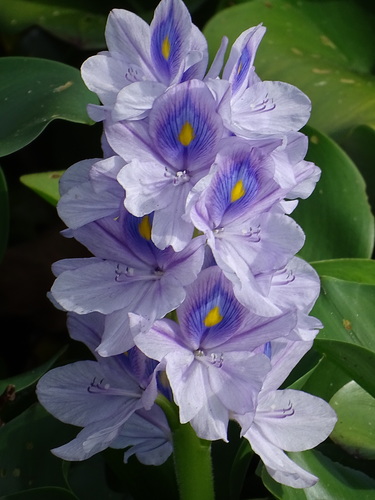
Pontederia crassipes Mart., commonly known as water hyacinth, is a free-floating perennial aquatic hydrophyte native to tropical and subtropical South America. It has broad, thick, glossy, ovate leaves that can grow up to 1 meter (3 feet) above the water surface. Individual leaves measure 10–20 cm (4–8 inches) across, growing on stems that float via buoyant bulb-like nodules at their base above the water. The plant has long, spongy, bulbous stalks, and feathery, freely hanging purple-black roots. An erect stalk supports a single spike of 8 to 15 prominently attractive flowers, which are most often lavender to pink in color and have six petals each. When not blooming, water hyacinth can be mistaken for frogbit (Limnobium spongia) or Amazon frogbit (Limnobium laevigatum). Water hyacinth is one of the fastest-growing known plants. It reproduces primarily through runners or stolons that eventually form new daughter plants. Each plant can also produce thousands of seeds annually, and these seeds can remain viable for over 28 years. Vigorous growth means mats of common water hyacinth can double in size in just one to two weeks. Counted by number of individual plants rather than total mat size, populations are reported to increase more than a hundredfold in as little as 23 days. In the species' native range, flowers are pollinated by long-tongued bees, and the plant can reproduce both sexually and clonally. The invasiveness of water hyacinth is linked to its clonal reproductive ability, and large patches are often all part of a single genetic individual. Water hyacinth is tristylous, meaning it has three distinct flower morphs categorized by pistil length: long (L), medium (M), and short (S). Tristylous populations only occur in water hyacinth's native lowland South American range. In regions where the species has been introduced, the M-morph is dominant, the L-morph occurs only occasionally, and the S-morph is entirely absent. This geographic pattern of floral morph distribution suggests founder events have played a major role in the species' spread across the world. Its natural habitat spans zones from tropical deserts to subtropical or warm temperate deserts, and extends into rainforest zones. Water hyacinth has defined temperature tolerance for growth: minimum growth temperature is 12 °C (54 °F), optimum growth temperature is 25–30 °C (77–86 °F), and maximum growth temperature is 33–35 °C (91–95 °F). Its estimated pH tolerance ranges from 5.0 to 7.5. Frost kills the species' leaves, and plants cannot tolerate water temperatures over 34 °C (93 °F). Water hyacinth will not grow where average salinity is higher than 15% that of seawater, approximately 5 grams of salt per kilogram of water. In brackish water, its leaves develop epinasty and chlorosis, and the plant eventually dies. Rafts of harvested water hyacinth floated out to the sea are killed by this salinity. The nitrogen-fixing bacteria Azotobacter chroococcum tends to be concentrated around the bases of water hyacinth petioles, but the bacteria do not fix nitrogen unless the plant is experiencing extreme nitrogen deficiency. Fresh water hyacinth plants contain prickly crystals. The plant is reported to contain hydrogen cyanide, alkaloids, and triterpenoids, and contact with it may cause itching. When growing in polluted environments, plants sprayed with 2,4-dichlorophenoxyacetic acid (2,4-D) can accumulate lethal doses of nitrates and other harmful elements. Around the world, NGOs and entrepreneurs have developed businesses that use water hyacinth to make furniture, handbags, baskets, rope, and household or interior goods such as lampshades and picture frames.