About Pontederia azurea Sw.
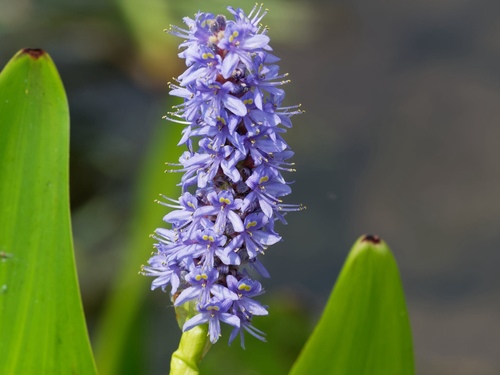
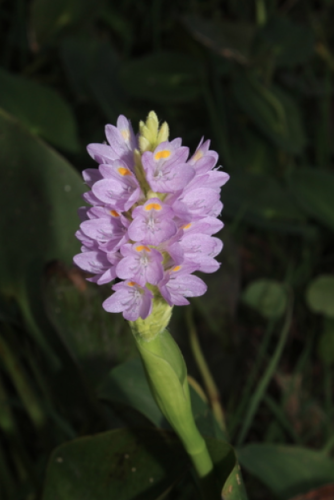
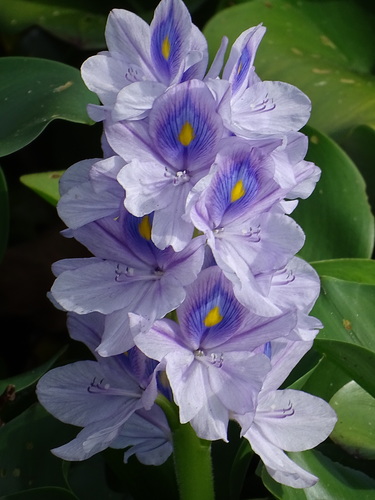
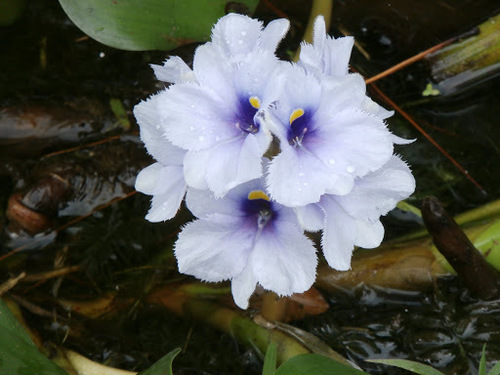
Pontederia azurea Sw., commonly called anchored water hyacinth, also goes by other common names including water orchid and floating water hyacinth. It is a free-floating aquatic perennial plant. It can be identified by its distinct thick, waxy green leaves that are rounded or elliptical in shape. Its long stems allow the plant to grow both below and above the water surface, and each single stem can produce up to 5 flowers. The plant bears large blossoms with lavender blue petals that have a yellow blotch at the center; the flowers strongly resemble lilac flowers. Each flower is made up of six petals, and individual petals are typically 2 inches wide. Anchored water hyacinth can grow up to three feet above the water surface, and is rooted in underwater soil.
This species, which is also referenced under the synonym Eichhornia azurea, is native to Central and South America, where it lives in warm bodies of water. It was introduced to New Orleans from South America in 1884 as an ornamental plant. Since its introduction, it has spread to the U.S. states of Alabama, Arkansas, California, Florida, Georgia, Hawaii, Indiana, Kentucky, Missouri, Mississippi, North Carolina, South Carolina, Texas, Virginia, and Vermont. It has also been introduced to Japan, China, Singapore, and New Zealand.
In the United States, Pontederia azurea is classified as a noxious species, and it is prohibited in the states of Alabama, Arizona, California, Florida, Massachusetts, North Carolina, Oregon, South Carolina, Texas, and Vermont. After introduction, the species grows very quickly and rapidly forms large, expansive mats of plants. Its population can double in size in just two weeks. It reproduces both by seed and via horizontal stems. When the plant withers, its stems bend, allowing it to release seeds into the soil below. Fragments of the plant can be transported to new locations and grow into new plants there.