About Pontania proxima (Serville, 1823)
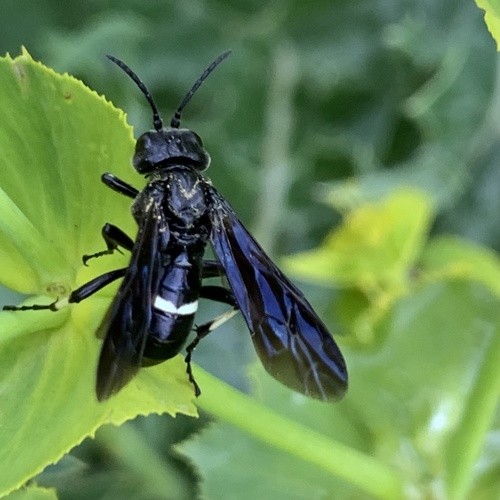
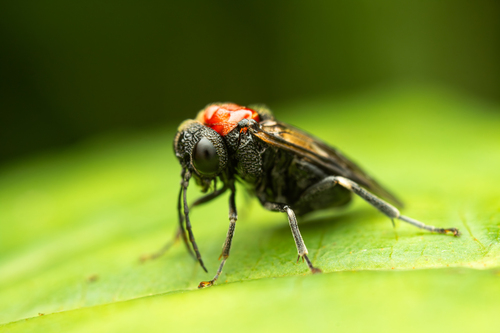
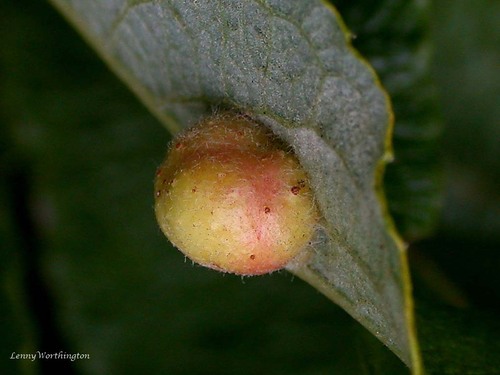
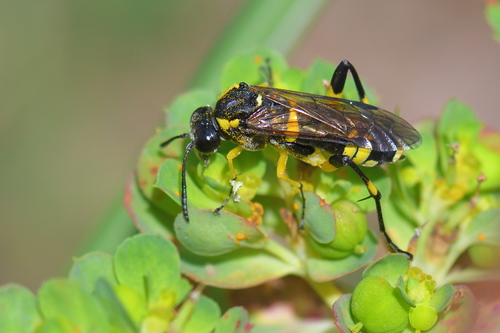
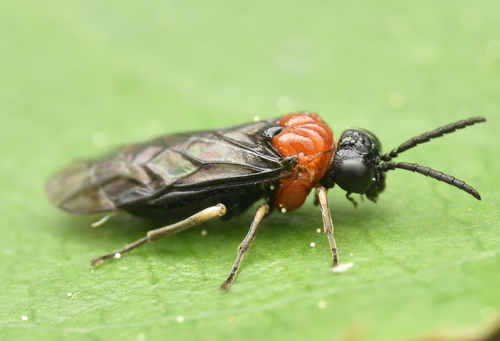
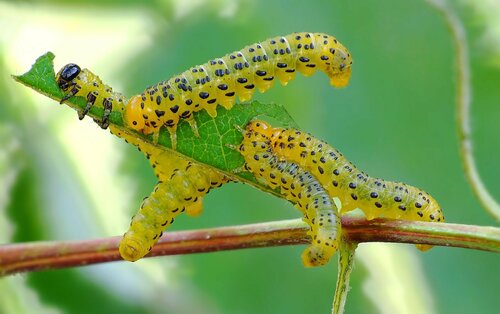
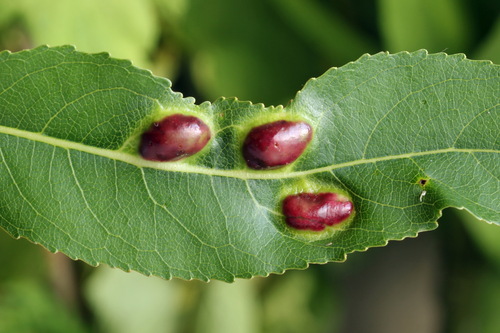
Pontania proxima (Serville, 1823), also referenced as Euura proxima, is a species of sawfly in the family Tenthredinidae, order Hymenoptera. Members of Hymenoptera are identified by four membranous wings, mandibulate mouthparts formed from multiple pairs of appendages attached to two unsegmented mandibles, and a true ovipositor. As larvae mature, their heads darken. After emerging from the gall they develop in, larvae form a fibrous cylindrical golden brown cocoon that incorporates soil particles and leafy matter; cocoon thickness varies based on the specimen’s developmental stage. Adult E. proxima have mostly black bodies with a brown tinge, and lighter reddish-brown legs. A distinguishing feature of this species is its thread-like antennae, which have shorter antennomeres than other similar species. This species forms ovoid, bean-shaped galls on willow leaves, measuring up to 12 mm by 6 mm. Galls form when a female lays her eggs and injects a substance into the leaf; the exact mechanism of gall formation is not fully understood, though evidence points to chemical induction and the involvement of phytohormones (plant hormones that regulate growth processes). Galls start out green, and develop a hard, thick red wall when they are occupied by a developing larva. As the larva consumes gall tissue, the gall walls soften. Unoccupied galls can occur, likely when no egg was laid or the egg failed to hatch. Multiple galls can grow on a single leaf, and they usually do not touch the leaf midrib. Known host willow species for these galls include white willow (Salix alba), weeping willow (S. babylonica), S. x blanda, S. excelsa, crack willow (S. fragilis), and bay willow (S. pentandra). This species is native to the Western Palearctic, and has been accidentally introduced widely across the globe. It is now found throughout Europe, ranging north to southern Finland and east to the Caucasus. It has also been introduced to Australia, North America, and New Zealand. Its widespread spread has been enabled by the spread of its host plants, such as Salix alba x fragilis. In New Zealand, it occurs across both main islands over a wide range of habitats, with only small populations found on the lower West Coast of the South Island and the lower East Coast of the North Island. The species’ habitat preference follows the distribution of its host willow plants. Like most willow sawflies, E. proxima feeds on plants in the Salicaceae family, and is classified as either monophagous or oligophagous. Host willows are abundant along riverbeds, especially in valleys, so alluvial environments are part of this species’ preferred habitat. It can also be found on willows growing near other aquatic environments including lakes and ponds. Adults emerge in spring, when host willows begin new development, particularly leaf growth, and then search for a suitable willow host. Females insert their ovipositor into leaf structure and implant eggs into the rapidly growing plant tissue. Galls begin forming as soon as the egg is inserted into leaf tissue. Eggs hatch 12 to 19 days after being laid, and galls reach their maximum size after two weeks. Newly hatched larvae live in a small cavity inside the gall, and eat through gall tissue until the gall walls become thin. Pontania proxima has two annual broods: the first matures around mid-summer, and the second matures in autumn. After leaving the gall, larvae form cocoons in the ground or in willow bark to pupate. Tenthredinid sawflies typically overwinter inside their cocoons before emerging as adults in spring. The summer-autumn brood of P. proxima hibernates in its cocoon, while the summer brood has a shortened development time to reach adulthood. In New Zealand, no males had been observed as of 2021, so the local population is thought to be parthenogenetic. This parthenogenesis is typical for the species group, and explains the observed uniform form of E. proxima. Most species in this group produce multiple generations per year. E. proxima is one of three closely related species in the Euura proxima group; the other two members are E. bridgmanii (Cameron, 1883) and E. triandrae (Benson, 1941).