About Pontania bridgmanii (Cameron, 1883)
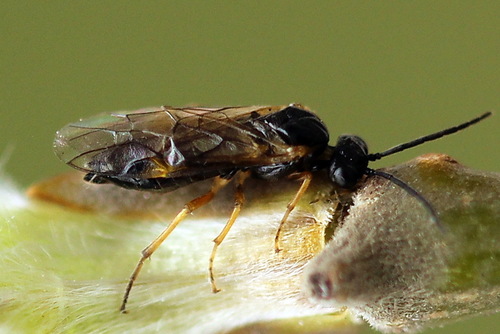
Pontania bridgmanii (Cameron, 1883) (also referenced as Euura bridgmani) forms galls on willow leaves. The gall develops when a female lays her eggs and injects a substance into the leaf. The ovoid gall measures up to 8 mm by 6 mm, is similar in appearance to galls of E. proxima, and often develops near or directly on the leaf midrib. When young, galls are green; as the larva inside grows, the gall softens and turns red. It often has a thin red rim along its upper surface. Galls of this species are found on the following willow species: eared willow (Salix aurita), goat willow (Salix caprea), grey willow (Salix cinerea), Salix appendiculata, Salix foetida, halberd willow (Salix hastata), tea-leaved willow (Salix phylicifolia), Salix silesiaca, Salix starkeana, and Salix waldsteiniana. Euura bridgmani is one of three closely related species belonging to the Euura proxima species group; the other two members of the group are E. proxima (Serville, 1823) and E. triandrae (Benson, 1941). This species is distributed across western, central, and northern Europe, with recorded occurrences in France, Great Britain, the Netherlands, Norway, and Sweden.