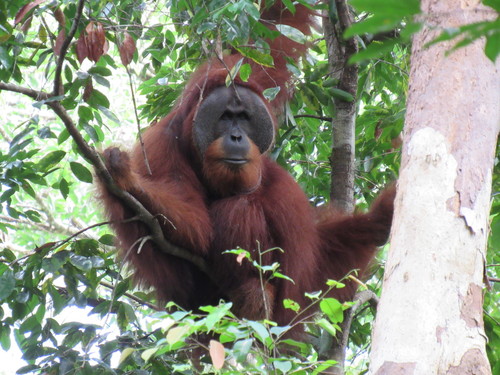
About Pongo abelii Lesson, 1827
Scientific name: Pongo abelii Lesson, 1827
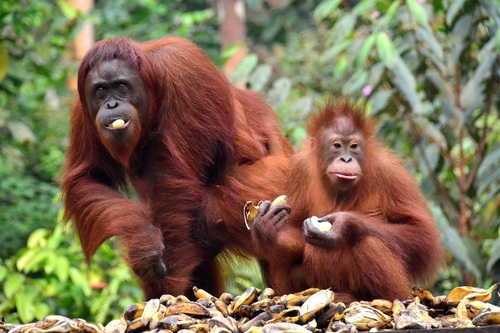
Description: Male Sumatran orangutans reach around 1.7 m (5.6 ft) in height and 90 kg (200 lb) in weight, while females are smaller, averaging 90 cm (3.0 ft) in height and 45 kg (99 lb) in weight. Compared to the Bornean orangutan, Sumatran orangutans have a slimmer build, longer faces, longer paler red fur.
Behaviour and ecology: Sumatran orangutans tend to be more frugivorous and especially insectivorous than Bornean orangutans. Their preferred fruits include figs and jackfruits, and they also eat bird eggs and small vertebrates. They spend far less time feeding on tree inner bark. Wild Sumatran orangutans in the Suaq Balimbing swamp have been observed using tools. An orangutan will break off a roughly foot-long tree branch, snap off its twigs, and fray one end with its teeth. The orangutan uses this stick to dig for termites in tree holes, and also to poke into bee nest walls, move the nest around and collect honey. Orangutans also use tools to access fruit. When Neesia tree fruit ripens, its hard, ridged husk softens and falls open. Inside are seeds that orangutans enjoy eating, but these seeds are surrounded by fiberglass-like hairs that cause pain if eaten. Orangutans create tools differently for different tasks, making sticks longer or shorter depending on whether the tool will be used to get insects or fruit. If a tool works well, orangutans will often save it, and over time can collect entire "toolboxes". An orangutan eating Neesia fruit will select a five-inch stick, strip off its bark, and carefully use the stick to remove the fiberglass-like hairs. Once the fruit is safe to eat, the ape eats the seeds with the stick or its fingers. Though similar swamps exist in Borneo, wild Bornean orangutans have never been observed using these types of tools. NHNZ filmed Sumatran orangutans for the show Wild Asia: In the Realm of the Red Ape; the footage showed one orangutan using a simple twig tool to pry food out of hard-to-reach places, and also included footage of an orangutan using a large leaf as an umbrella during a tropical rainstorm.
Tree branches serve both as tools and as a means of travel for Sumatran orangutans. Orangutans are the heaviest mammals that travel exclusively through trees, which makes them particularly sensitive to changes in arboreal branch compliance. To adapt to this, their locomotion is defined by slow movement, long contact times with branches, and a very wide range of locomotor postures. Orangutans even use the compliance of vertical supports to reduce their locomotion energy cost by swaying trees back and forth, and have unique locomotion strategies: they move slowly and use multiple supports to limit oscillations in flexible branches, especially at branch tips. Sumatran orangutans are also more arboreal than Bornean orangutans, which may be due to the presence of large predators such as the Sumatran tiger. They move through trees using quadrumanous locomotion and semibrachiation.
As of 2017, the total remaining population of Sumatran orangutans is approximately 13,846 individuals. The World Wide Fund for Nature runs conservation efforts that allow Sumatran orangutans to reproduce in safe captive environments, but this practice carries a risk to the species' natural wild behaviors. Orangutans held in long-term captivity can develop the "Captivity Effect": they lose the ability to behave naturally when returned to the wild. When provided with constant water, food, and shelter in captivity, and lacking the natural challenges of wild life, captive orangutans develop more exploratory behavior patterns. Researchers have identified a repertoire of 64 distinct gestures used by Sumatran orangutans. 29 of these gestures are thought to have a specific meaning that is correctly interpreted by other orangutans most of the time. Six clear intentional meanings have been identified: Affiliate/Play, Stop action, Look at/Take object, Share food/object, Co-locomote, and Move away. Sumatran orangutans do not use sound as part of their communication, including a lack of audible danger signals, and rely entirely on gestures for communication. In 2024, a wild Sumatran orangutan named Rakus was observed applying a paste made from chewed Fibraurea tinctoria leaves to a facial wound; the wound appeared to heal completely within weeks after this treatment.
Life cycle: Sumatran orangutans go through five distinct life stages, each defined by unique physical and behavioral traits. The first stage is infancy, which lasts from birth to around 2.5 years of age. Infant orangutans weigh between 2 and 6 kilograms. Infants can be identified by light pigmented areas around the eyes and muzzle that contrast with darker pigmentation on the rest of the face, along with long hairs that protrude outward around the face. During infancy, the infant is always carried by its mother while traveling, is highly dependent on the mother for food, and sleeps in the mother's nest. The second stage is juvenilehood, which occurs between 2.5 and 5 years of age. Juvenile orangutans weigh between 6 and 15 kilograms, and do not look dramatically different from infants. While juveniles are still mostly carried by their mother, they will often play with peer juveniles and make short exploratory trips while staying within sight of the mother. Towards the end of this stage, juveniles stop sleeping in their mother's nest and build their own nest close by. The third stage is adolescence, which takes place from 5 to 8 years of age. Adolescent orangutans weigh between 15 and 30 kilograms. The light pigmented patches on the face begin to fade, until the entire face becomes fully dark. During this stage, orangutans still stay in constant contact with their mothers, but develop stronger relationships with peers while playing in groups. They are still young and act cautiously around unfamiliar adults, especially adult males. At 8 years of age, female orangutans are considered fully developed and begin having their own offspring. Males, by contrast, enter a sub-adulthood stage. This stage lasts from 8 years of age to around 13 or 15 years of age. Sub-adult male orangutans weigh between 30 and 50 kilograms. Their faces are completely dark, and they begin to develop cheek flanges. Their beard starts to grow in, while the hair around their face shortens, and the face flattens along the skull instead of having hairs that point outward. This stage marks sexual maturity in males, but these orangutans are still socially underdeveloped and will avoid contact with adult males. Finally, male Sumatran orangutans reach adulthood at 13 to 15 years of age. Adult males are very large, weighing between 50 and 90 kilograms, around the weight of a fully grown human. They have a fully grown beard, fully developed cheek callosities, and long hair. These adult males have reached full sexual and social maturity, and travel alone exclusively.
Female Sumatran orangutans typically live 44–53 years in the wild, while males have a slightly longer maximum lifespan of 47–58 years. Studies of menopausal cycles have found that females can give birth up to 53 years of age. Both males and females usually remain healthy even at the end of their lifespans; good health is marked by consistent abundant hair growth and robust cheek pads. Sumatran orangutans are more social than Bornean orangutans; groups will gather to feed on the large quantities of fruit produced by fig trees. Sumatran orangutan communities are best described as loose, with no social or spatial exclusivity. Groups generally are made up of clusters of females and one preferred male mate. However, adult males generally avoid contact with other adult males. Subadult males will attempt to mate with any female, though these mating attempts are mostly unsuccessful, because mature females are easily able to fend them off. Mature females prefer to mate with mature males, and usually have a specific preferred male within their group. Male Sumatran orangutans sometimes experience a multi-year delay in the development of secondary sexual characteristics such as cheek flanges and muscle mass. Males display bimaturism: both fully flanged adult males and smaller unflanged males are able to reproduce, but use different mating strategies to do so. The average interbirth interval for Sumatran orangutans is 9.3 years, the longest recorded for any great ape including the Bornean orangutan. Infant orangutans stay close to their mothers for up to three years, and will continue to associate with their mothers even after this period. Both Sumatran and Bornean orangutans can live for several decades, with an estimated longevity of over 50 years. The average age of first reproduction for male P. abelii is around 15.4 years old. There is no confirmed evidence of menopause in this species. Nonja, thought to be the world's oldest orangutan in captivity or the wild at the time of her death, died at Miami MetroZoo at the age of 55. Puan, an orangutan at Perth Zoo, is believed to have been 62 years old when she died, making her the oldest recorded orangutan. The current oldest living orangutan in the world is believed to be Bella, a female orangutan at Hagenbeck Zoo, who is 61 years of age.