About Pomoxis nigromaculatus (Lesueur, 1829)
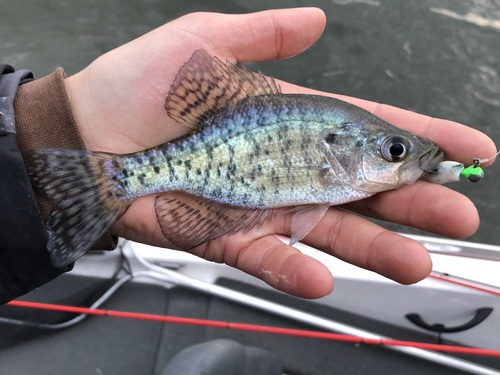
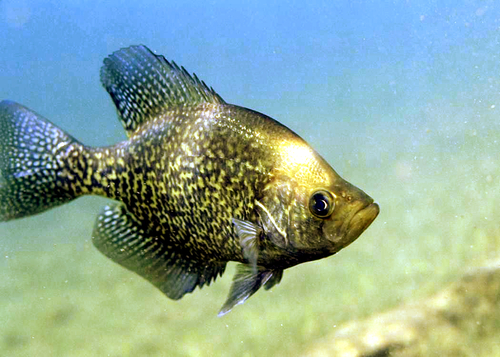
Black crappie, scientifically named Pomoxis nigromaculatus, can be most accurately identified by the seven or eight spines on its dorsal fin, while the closely related white crappie has five or six dorsal spines. All crappies have a deep, laterally compressed body. Black crappies are typically silvery-gray to green in color, with irregular or mottled black splotches covering their entire body. They also have rows of dark spots on their dorsal, anal, and caudal fins, and the dorsal and anal fins share a similar shape. Both black and white crappies have large mouths that extend below the eye, paired with thin lips; these features are consistent with their piscivorous feeding habits. Most adult black crappies are 4–8 inches (10–20 cm) long. The current all-tackle fishing world record for black crappie stands at 2.47 kg (5 lb 7 oz). The maximum reported length for the species is 19.3 inches (49 cm), and the maximum published weight is just under 6 pounds (2,700 g). The native range of black crappie is considered uncertain because the species has been widely transplanted, and it is assumed to be similar to that of the white crappie. Researchers suspect its native range covers eastern Canada and the eastern United States; as of 2005, established populations existed across all 48 contiguous U.S. states. Introduced populations are also found in Panama and Mexico. Black crappie inhabit lakes, reservoirs, borrow pits, and navigation pools in large rivers. They favor areas with little to no current, clear water, abundant cover such as submerged timber or aquatic vegetation, and sand or mud bottoms, which are common in lakes, ponds, streams, and sloughs. Like the white crappie Pomoxis annularis, black crappie is highly prolific and can easily overpopulate its environment, causing negative impacts for both its own population and other local fish species. However, one commercial fish supplier claims that black crappie can be safely stocked in ponds as small as one acre (0.40 hectares) in area. Black crappie reach sexual maturity at two to four years of age. Over the first four years of life, growth is faster in the warm southern waters of their range than in the cooler northern waters. White crappie has a faster growth rate in terms of body length than black crappie. Most black crappies caught for recreational sport are between two and five years old. The breeding season varies by location across the species' wide range. Breeding occurs at water temperatures between 14–20 °C (58–68 °F), so spawning takes place in spring and early summer. Spawning happens in a nest constructed by the male. Males sweep out an area of sand or mud in shallow water between one and six feet deep, usually close to shore and near vegetation, to build their nest. Black crappie males tend to build their nests in the most protected locations available, such as areas with woody debris or live vegetation. On average, a female black crappie produces 40,000 spherical eggs, and the exact number depends on the female's age and size. After spawning, the male guards the nest until the eggs hatch, which typically takes two to three days. Newly hatched black crappie larvae are around 2.32 millimetres (0.091 in) long and translucent. They remain in the nest for several days before moving to shallow, sheltered waters. The oldest recorded age for a black crappie specimen is fifteen years, though a seven-year lifespan is more typical for the species.