About Pomoxis annularis Rafinesque, 1818
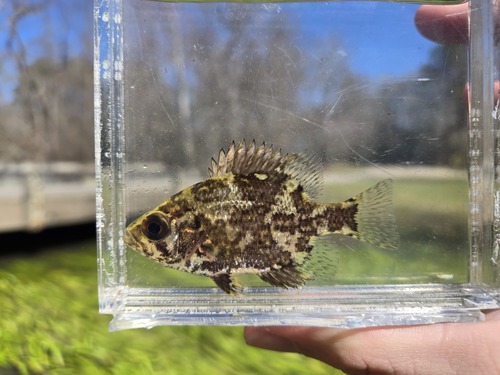
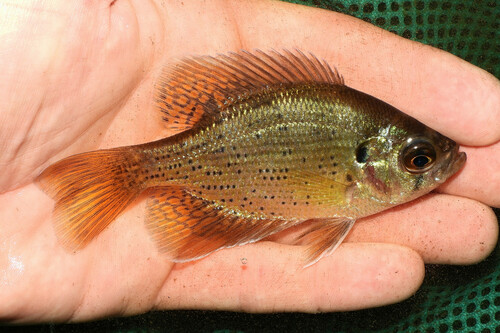
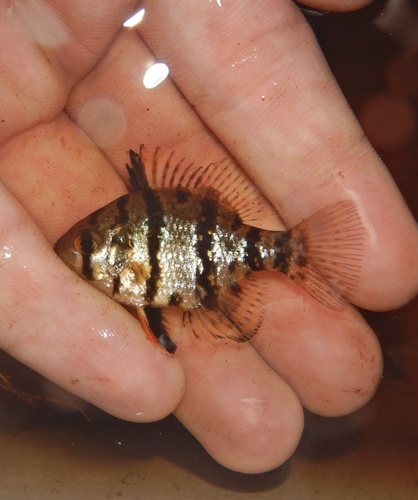
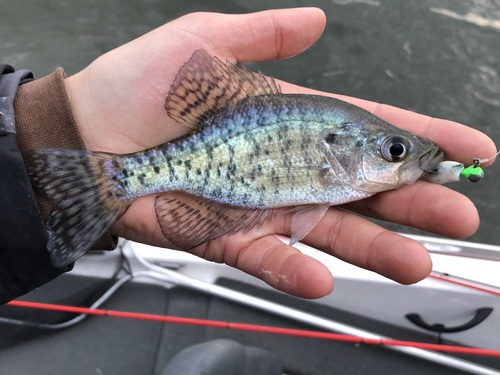
White crappie (Pomoxis annularis Rafinesque, 1818) is a fish species morphologically similar to black crappie (Pomoxis nigromaculatus), but differs in several key traits. Instead of the randomly scattered spots seen on black crappies, white crappies have 5 to 10 dark vertical bars along their bodies. Their base body color is silvery, with green or brown shading along the back, dark lateral bars on the sides, and a white belly. Compared to black crappies, the dorsal fin of white crappie starts farther back on the body. The white crappie's anal fin is approximately the same size as its dorsal fin, and it has six dorsal fin spines, while black crappies have seven or eight. White crappies are also slightly more elongated than black crappies. This is a deep-bodied, flattened fish species; its body depth is equal to one-third of its total body length. White crappies have spinous rays and ctenoid scales, a type of scale found in advanced teleost fish. The exposed portion of each ctenoid scale has tiny tooth-like projections called cteni. Like black crappies, white crappies have a terminal mouth, with many small conical teeth arranged in two rows along the mouth. This tooth arrangement is called cardiform, because it resembles a tool used for wool carding. Crappies are part of the family Centrarchidae, in the order Perciformes, within the class Actinopterygii. Adult white crappies are generally 9 to 10 inches (23 to 25 cm) long, and the species rarely exceeds 2 pounds (0.91 kg). Their typical lifespan ranges from 2 to 7 years. The current International Game Fish Association (IGFA) all-tackle world record for the heaviest white crappie is 2.35 kg (5.2 lb), caught July 31, 1957 near Enid Dam, Mississippi by angler Fred Bright. The IGFA all-tackle world record for the longest white crappie is a 39-centimetre (15 in) fish, caught October 14, 2022 in Grenada Lake, Mississippi by angler Doug Borries. White crappies are native to the Great Lakes, Hudson Bay, and the Mississippi River basins, with a native range extending from New York and southern Ontario west to South Dakota, and south to Texas. This species has a large geographic range across the United States, with a currently stable population, and is listed as a least concern species for conservation. White crappies inhabit large rivers, reservoirs, and lakes. They are more tolerant of turbid, murky water than black crappies, and usually outnumber black crappies in turbid waters. They also typically outnumber black crappies in areas with little rooted aquatic vegetation. White crappies are most often found in rivers, and in low-velocity areas of rivers such as pools and backwaters. They are most abundant in lakes and reservoirs larger than 5 acres. During mornings and evenings, white crappies can be found in open water; during the day, they occupy shallower, quiet waters 6 to 12 feet (1.8 to 3.7 m) deep, surrounded by structure. White crappies spawn in May and June, when water temperature reaches 56 °F (13 °C). Males build nests by digging small, bowl-shaped depressions in the shallow water bottom, near brush, rocks, and logs. During the spawning season, males develop dark coloration on their throats. Females lay between 5,000 and 30,000 eggs. Males guard the nests until the newly hatched fry swim away, a behavior that improves the chance their genes are successfully passed to the next generation. White crappies typically grow 3 to 5 inches (7.6 to 12.7 cm) in their first year of life, and grow an additional 3 to 4 inches in their second year. They reach sexual maturity around their second or third year. The maximum lifespan of white crappies is 8 to 10 years. The average lifespan is 3 to 4 years in unmanaged waters, and 6 years in managed waters.