About Pomatostomus superciliosus (Vigors & Horsfield, 1827)
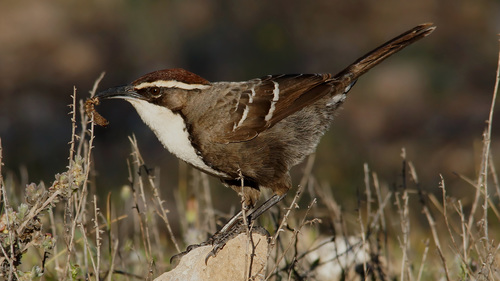
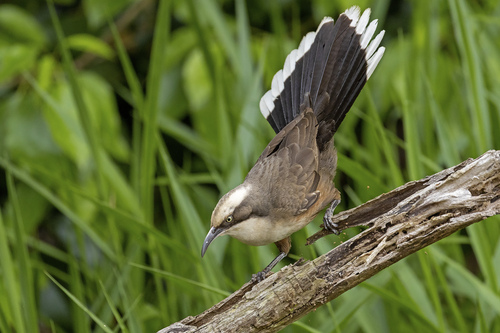
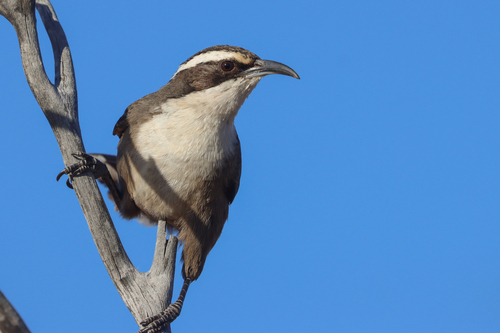
The white-browed babbler (Pomatostomus superciliosus) measures 17 to 21 centimeters in length, making it the smallest species of Australian babbler. It is a medium-sized terrestrial bird with a long, decurved bill, short rounded wings, and a plump full body that is similar in shape but slightly smaller than the bodies of the chestnut-crowned babbler and Hall's babbler. Its tail is long and graduated, ending in a rounded tip. Because this species is gregarious, its tail is often fanned, raised, or both. Plumage color varies across individuals, but adults are generally dark grey-brown to solid dark brown, with a distinct white supercilium and a dark brown eye stripe. The underside of the body is usually lighter, ranging from light grey or white to light brown; females are sometimes lighter than males, but the sexes are generally similar in appearance. Juveniles typically have darker, more pronounced plumage with a chestnut or cinnamon tone, especially on the underside. Breeding adult males may sometimes have a more distinct brown cap compared to females or juveniles. The white-browed babbler occupies a range of habitat types across southern regions of Australia, including dry sclerophyll woodlands, shrublands, heathland, semiarid grasslands, and open forests. It prefers areas with a dense understory of shrubs or spinifex, which it uses for protection and nesting. Its range extends through arid and semiarid areas all the way across the South Australian coastline to Western Australia, crossing many different ecological vegetation classes (EVCs). The species shows no clear preference for specific overall habitat composition; it is more successful in any habitat where the understory provides good quality protection from the environment and predators. Populations have been recorded across a wide range of locations in southern Australia, including dry rocky gibber desert, mulga, eucalyptus woodlands, and acacia woodlands. Studies have also found many populations in and around human-built infrastructure. White-browed babblers spend most of their time foraging through leaf litter on the ground, though during nesting periods they retreat to nests inside hollowed logs, grass clumps, fallen branches, or shrubs. Populations of the white-browed babbler occur across the entire southern mainland of Australia. They are generally found south of the Tropic of Capricorn, spanning from the east coast to the west coast of the country. Populations in central Australia tend to be more isolated than populations located closer to the coast.