About Pomatostomus ruficeps (Hartlaub, 1852)
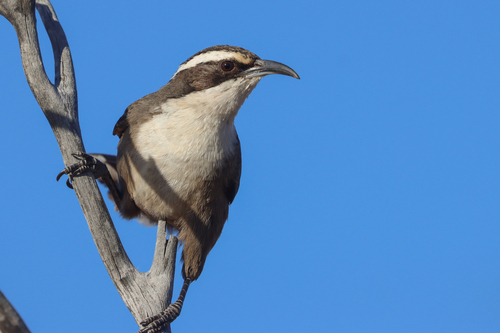
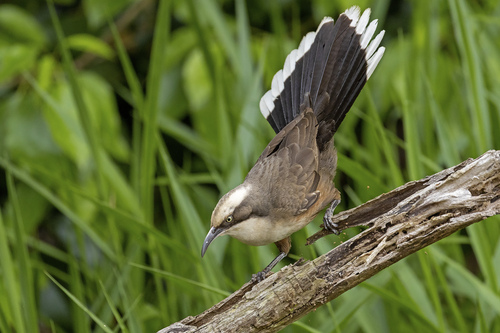
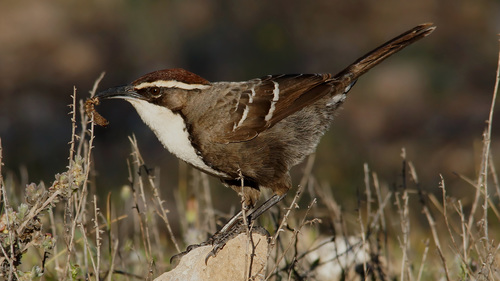
Chestnut-crowned babbler (Pomatostomus ruficeps) is a species of bird with distinct physical characteristics. This bird is dark brown-grey overall, with a white throat and breast, a white-tipped tail, and a long, black, down-curved bill. Its wings are short and rounded, and its long tail also has a rounded tip. Key identifying features are two white wing bars, a rich chestnut crown, and prominent long white eyebrows. The eyes are dark brown, the legs are grey, and the wings, back, and flanks range from brown-grey to mottled dusky on the upper mantle. The white patch on the throat and breast is sharply defined, and it is narrower than the corresponding white patch of the closely related white-browed babbler (Pomatostomus superciliosus). Together, these traits give the chestnut-crowned babbler a distinctive appearance. Adults measure 21–23 cm in length and weigh approximately 50 g, making them noticeably smaller than the grey-crowned babbler (Pomatostomus temporalis), and they also appear slimmer than other babbler species. Adult chestnut-crowned babblers are sexually monomorphic, meaning males and females have no visible external differences. Immature birds resemble adults but have duller overall plumage, with pale rufous eyebrows and chest, a brown crown, and a whitish patch behind the eye. This species is found in inland areas of south-eastern Australia, including parts of western New South Wales, south-western Queensland, eastern South Australia, and north-western Victoria. Its range covers the south-eastern Lake Eyre Basin and the western Murray-Darling Basin. It most commonly lives in drier, more open mallee, mulga, and belar woodlands than the woodlands inhabited by the white-browed babbler and Hall's babbler (Pomatostomus halli). Additional habitats it occupies include acacia and cypress pine scrubs and woodlands, stony ground, sandhills, and areas dominated by lignum, saltbush, and samphire. The species is most easily observed at Eulo Bore, Bowra Station, Hattah-Kulkyne National Park, and along many outback roads, including the routes between Quilpie and Windorah, and between Bourke and Nyngan.