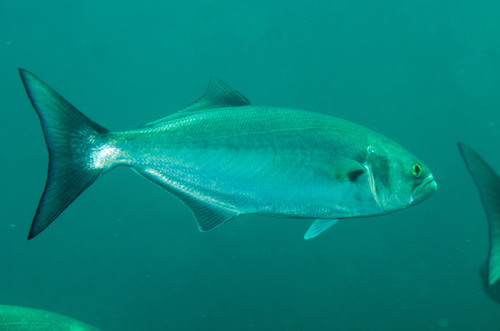
About Pomatomus saltatrix (Linnaeus, 1766)
Pomatomus saltatrix, commonly known as bluefish, is the only living species in the family Pomatomidae. It is a marine pelagic fish that occurs worldwide in temperate and subtropical waters, with the exception of the northern Pacific Ocean. It has different regional common names: it is called tailor in Australia and New Zealand, and elf and shad in South Africa. Bluefish is a popular gamefish and food fish. Bluefish have moderately proportioned bodies, with a broad, forked tail. The spiny first dorsal fin, along with the pectoral fins, is normally folded back into a groove. Its dorsal coloration is grayish blue-green, which fades to white on its lower sides and belly. Each jaw has a single row of teeth that are uniform in size, knife-edged, and sharp. Common sizes of bluefish range from 7-inch (18 cm) "snappers" to much larger individuals that can sometimes reach 40 lb (18 kg) in weight, though fish heavier than 20 lb (9 kg) are very uncommon. Bluefish are widely distributed globally in tropical and subtropical waters. They occupy pelagic waters across most continental shelves, occurring along eastern America (with a gap between south Florida and northern South America), Africa, the Mediterranean and Black Seas (including migration routes between the two), Southeast Asia, and Australia. They live in a range of coastal habitats: above the continental shelf, in energetic waters near surf beaches, and adjacent to rock headlands. They also enter estuaries and live in brackish waters. Periodically, bluefish leave coastal areas and migrate in schools through open waters. Along the U.S. East Coast, bluefish are found off Florida during winter. They leave Florida and head north by April, and can be found off Massachusetts by June; in years of high population abundance, individual stragglers may reach as far north as Nova Scotia. By October, bluefish leave waters north of Cape Cod, and move south along the U.S. East Coast from Rhode Island south to Georgia, eventually reaching the waters off Florida. Some bluefish, likely less migratory individuals, remain in the Gulf of Mexico year-round. The economically important bluefish population that spawns in Europe's Black Sea follows a broadly similar migration pattern: it moves south through Istanbul via the Bosphorus, Sea of Marmara, Dardanelles, and Aegean Sea, and continues to Turkey's Mediterranean coast in autumn to spend the cold season there. In 2013, a protection campaign for bluefish was launched in Turkey by Fikir Sahibi Damaklar (Intelligent Palates). More recent reports note that bluefish are abundant near Istanbul, and an annual fishing ban is in place from April 15 to September 1 to protect fish eggs and support sustainable fishing. Bluefish along the South African coast follow roughly parallel migration patterns. For culinary use, bluefish can be prepared by baking or smoking. Smaller bluefish called "snapper blues" are typically fried, as they are not very oily. Because bluefish has a higher fat content, it goes rancid very quickly, so it is generally not sold far from its fisheries. However, where bluefish is available, it is usually inexpensive. Bluefish must be refrigerated and consumed soon after purchase; some recipes call for marinating it in vinegar and wine before cooking, prepared as vina d'alhos or en escabeche.

