About Pomaderris apetala Labill.
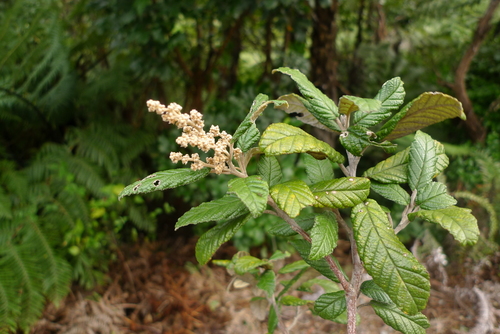
Pomaderris apetala Labill. is a small tree or large shrub in the family Rhamnaceae, found growing in Victoria, Tasmania, and New Zealand. In New Zealand, this species is commonly called the New Zealand Hazel, and its traditional Māori names are tainui, nonokia, and nonorangi. The name 'Tainui' is traditionally traced back to P. apetala plants said to have sprung from the skids of the 'Tainui' canoe, carried by the Māori who first colonised New Zealand.
Both recognised subspecies of P. apetala occur in Tasmania and Victoria, but only P. apetala subsp. maritima is found in New Zealand. In Victoria, P. apetala subsp. apetala grows in the Greater Grampians and Highlands-Southern Fall bioregions, while P. apetala subsp. maritima is restricted to the Gippsland Plain and Wilsons Promontory bioregions. In New Zealand, P. apetala is mostly limited to the North Island and the northern part of the South Island. In Tasmania, P. apetala subsp. apetala is widespread across the state, while P. apetala subsp. maritima is mostly restricted to Flinders Island, and the northern and eastern coasts of Tasmania.
P. apetala can be found on the margins of fern gullies and along stream edges, and it is a common riparian species in south eastern Tasmania. P. apetala subsp. maritima has been recorded growing on low dunes and sea cliffs. In Tasmania, P. apetala is typically one of the main components of the understorey in Tasmanian wet sclerophyll forest, and it occurs most commonly in wet sclerophyll forests growing on fertile sites. P. apetala can also form canopies in dry rainforests, which are typically located in fire-protected gullies and scree slopes on drier sites. P. apetala has also been recorded growing in mixed forest and rainforest sites that have been disturbed by logging or fire.
Pomaderris apetala is useful for stabilising streamsides thanks to its strong soil-binding qualities. Its wood is suitable for carving, fine turning work, and making drawing instruments. This species is also known to have low flammability, making it a valuable replacement for highly flammable plants, and it can be grown in Building Protection Zones (also called Asset Production Zones) — the areas surrounding homes in bushfire-prone areas that are kept with minimal fuel loads.
In cultivation, P. apetala can be propagated from fresh seeds or cuttings taken from firm young growth. It is frost hardy, and grows best when planted in moist, acidic, well-drained soils in a shady location.