About Pomadasys kaakan (Cuvier, 1830)
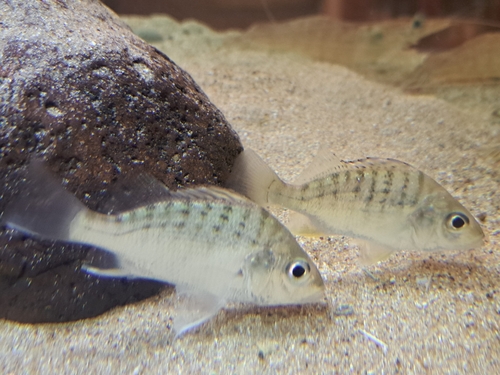
Pomadasys kaakan has a blunt head with a convex upper profile, and a small mouth that holds brush-like bands of teeth on its jaws. The chin has two pores and a central pit. Juvenile individuals have a bright silvery green back, golden silver flanks, and silvery white underparts, with at least 12 faint vertical bars formed from small dark brown spots or irregular blotches. The spiny section of the dorsal fin has blackish-brown spots on its base, the soft-rayed part of the dorsal fin has three rows of spots and a dark margin, and the lower tip of the caudal fin is milky in color. Adult individuals have plain golden green upper bodies and silver lower bodies; the vertical bars and dorsal fin spots seen in juveniles are indistinct or entirely absent in adults. This species has 12 spines and 13 to 15 soft rays in the dorsal fin, while the anal fin holds 3 spines and 7 soft rays. It reaches a maximum total length of 80 cm (31 inches), with 50 cm (20 inches) being a more typical size. Pomadasys kaakan occurs in the Indo-Pacific region. Its range extends along the eastern coast of Africa from the Red Sea to the Eastern Cape, along the southern coast of Asia (including the Persian Gulf) to China and Taiwan, and along the northern coasts of Australia from Exmouth Gulf in Western Australia to Moreton Bay in Queensland. It can also be found in the Comoro Islands, Madagascar, the Seychelles, and the Farquhar Islands. This fish lives in turbid coastal waters over sand or mud substrates, down to depths of 75 metres (246 feet). It will enter estuarine environments and may tolerate low-salinity water. It is frequently found in and around inshore shipwrecks, and is also recorded from coral and rocky reefs. It spawns in shoals near river mouths during the winter. It is oviparous and forms distinct pairs for spawning. Its diet consists mostly of crustaceans, and it also feeds on fishes, molluscs, brittle stars, Lingula sp., and algae.