About Pomacea maculata Perry, 1810
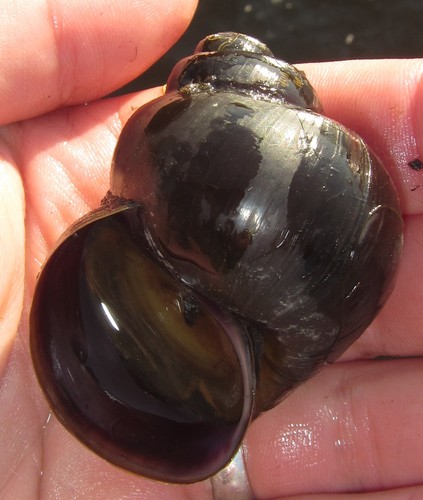
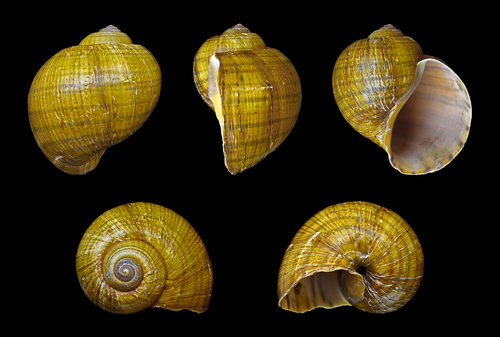
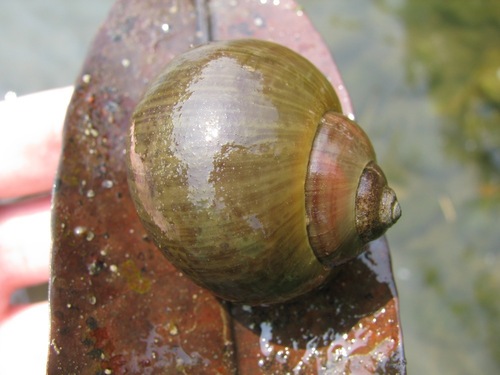
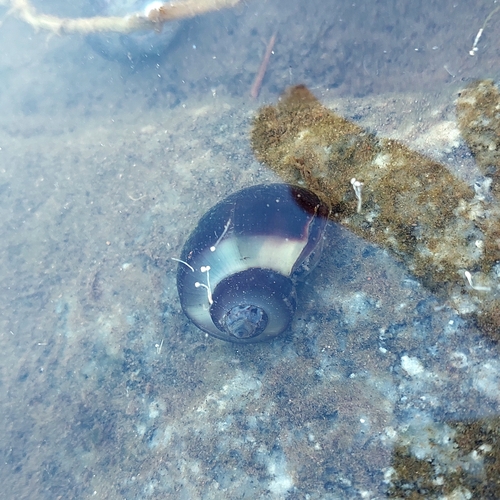
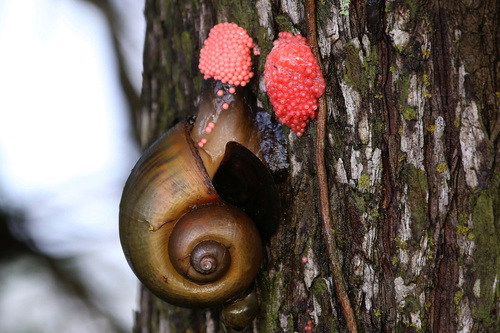
This species of apple snail, Pomacea maculata, was formally described by Georges Perry in March 1810. Perry established the genus Pomacea, and designated P. maculata as the genus type species. The snail can reach a maximum size of 15 centimeters (5.9 inches, or 150 millimeters) in shell length. Its eyes are positioned directly below the antennae. Shell shape is globular, with an average of 5 to 6 whorls that coil dextrally. Compared to other members of the apple snail family, the shell is relatively thin, and its inner surface has dark spots—this matches the species epithet maculata, which means spotted or stained. Shell base color ranges from pale olive green to darker green, marked with dark bands across the shell; normal coloration can also include bands of brown, black, and yellowish-tan. The lip of the shell’s large aperture typically ranges from yellow to reddish-orange. Overall shell color patterns are extremely variable, with both albino and golden color morphs known. The operculum of P. maculata is dark brown, and it can be used to distinguish males from females: females have an operculum with uniform concavity, while the male operculum has uneven concavity. The soft visible body of the snail is grey-brown with dark spots. Morphologically, P. maculata can be hard to tell apart from the closely related Pomacea canaliculata, but their egg masses are clearly different to a trained observer. The easiest distinguishing trait of egg clutches is that an individual P. maculata clutch holds a noticeably larger number of eggs than a P. canaliculata clutch. The native range of Pomacea maculata is South America. It has been confirmed present in Argentina, Brazil, and Bolivia, and it likely also occurs in Uruguay and Paraguay. The species’ type locality is the Río Paraná, which joins the Río Uruguay just north of Buenos Aires to form the Río de la Plata. The area between these two rivers is the Argentine province of Entre Ríos; the southern part of this province is marshy, with channels connecting the Paraná and Uruguay. P. maculata lives along the edges of freshwater habitats including lakes, ponds, and wetlands. It also commonly colonizes small water bodies like roadside ditches, as well as the littoral edges of larger water bodies. Laboratory experiments with adult and juvenile P. maculata collected in Texas found the following incipient physiological tolerance limits: salinity from 0.0 ‰ to 6.8–10.2 ‰, pH from 3.5–4.0 to 10.0–10.5, and temperature from 15.23 °C to 36.6 °C. The snails may also use behavioral adaptations such as burrowing to tolerate low temperatures, a behavior they could not display during the laboratory trials. Their tolerance to emersion ranges from 70 days at 30 °C with less than 5% relative humidity, to more than 308 days at 20–25 °C with over 75% relative humidity. P. maculata exhibits sexual dimorphism, with females generally growing larger than males. It reproduces sexually, with internal fertilization of eggs. Females can store sperm after a single mating, allowing them to produce multiple clutches of eggs from one mating event. Females are able to produce a full clutch of eggs within their first year of life. Females lay clutches of pink eggs above the waterline, attaching them to vegetation or rocky surfaces. Prolonged submergence in water will damage these eggs and cause them to die. A single P. maculata clutch holds between 1500 and 2100 eggs. An individual snail can lay up to 56,000 eggs over its lifetime. When first laid, eggs are a very bright, saturated pink. As they dry over time, they become ashy and less saturated in color, and turn white just before hatching. The entire clutch typically hatches 10 to 14 days after being laid. Pomacea maculata is edible, and is part of the ornamental pet trade for freshwater aquaria. It is often mislabeled with incorrect, vague names when sold in the aquarium trade. Research has explored the use of P. maculata as a biomonitoring species, because these snails accumulate heavy metals in their opercula; opercula can then be analyzed to detect toxic metals in the surrounding environment.