About Pomacea canaliculata (Lamarck, 1822)
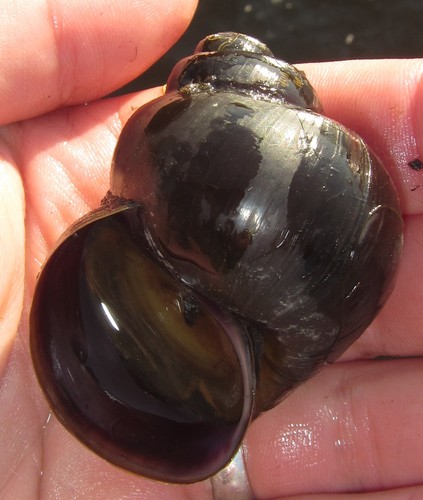
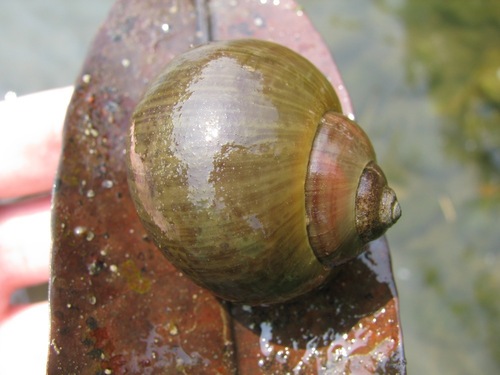
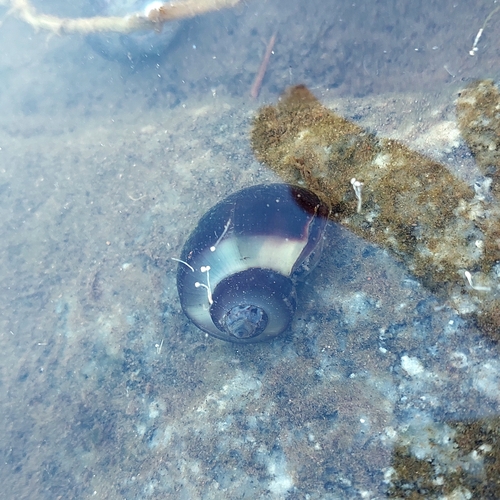
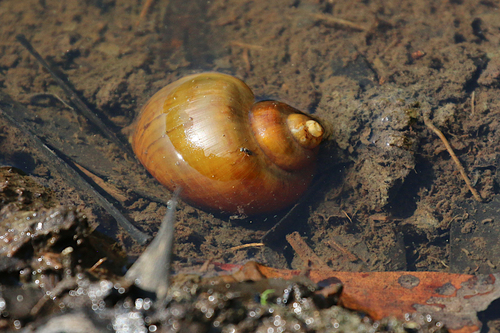
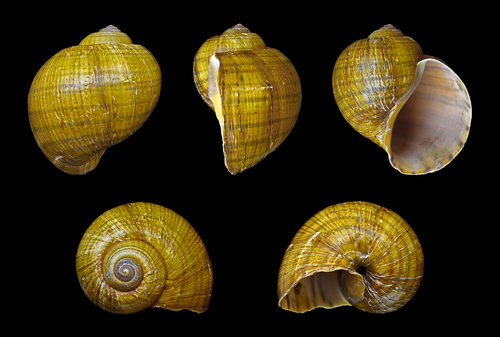
Pomacea canaliculata, commonly called the channeled apple snail, has a globally globular shell. Normal shell coloration is typically made up of bands of brown, black, and yellowish-tan, with extremely variable color patterns; albino and golden color variations also exist. The maximum recorded shell length is 150 millimetres (6 inches).
This species is native to tropical and subtropical regions of South America, including Argentina, Bolivia, Paraguay, Uruguay, and Brazil. Its southernmost confirmed native occurrence is at Paso de las Piedras reservoir, south of Buenos Aires province, Argentina. It has been introduced to many non-native regions across the world. In the United States, initial introductions were likely from aquarium release, also known as "aquarium dumping". Confirmed non-native locations within the US include Lake Wawasee in Kosciusko County, Indiana; Langan Park and Three Mile Creek in Mobile, Alabama; a pond bordering the Mobile-Tensaw River Delta in Baldwin County, Alabama; Little Wekiva River, Orlando, Florida; a lake near Jacksonville, Florida; Miramar Reservoir in San Diego County, California; and a pond near Yuma, Arizona. Established non-native populations exist in California and Hawaii. Further north in Canada, the Government of Alberta has classified channeled apple snails as an invasive species; Alberta's Minister of Environment and Protected Areas Rebecca Schulz and the Alberta Invasive Species Council work to address this species as part of their goal to eliminate invasive species from the province. The species was first recorded in China in 1981, with its initial introduction point in Zhongshan city. It was first recorded in Chile in 2009, where it currently has a restricted distribution. It has also been found in the Philippines, Japan, Korea, Taiwan, Vietnam, Cambodia, Laos, Papua New Guinea, parts of Indonesia and Malaysia, Singapore, and Guam. It was first introduced to Southeast Asia in 1980, intended for use as a food item and aquarium pet, first brought to Taiwan, then Japan, Thailand, and the Philippines. The species did not become popular as intended, and many individuals were released or escaped into the wild, where it has become a major agricultural pest. The first confirmed records of this species in Kenya (and the first confirmed records in continental Africa) come from samples collected 3 December 2020 in Mwea Constituency, Kirinyaga County.
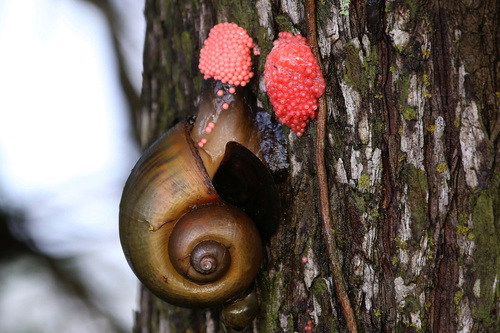
Pomacea canaliculata inhabits freshwater lakes, rivers, ponds, and swamps, and can tolerate a wide range of temperatures. In their natural habitats, they lay their eggs on grasses and other emergent vegetation that grows along the edges of water bodies. In areas where they are invasive, they can use agricultural crops such as rice and taro as a substrate for egg-laying.
The species' reproductive timing varies by climate: in temperate regions, the egg-laying period runs from early spring to early fall, while reproduction happens year-round in tropical regions. The length of the reproductive period decreases as latitude increases, reaching a minimum of six months at the southern limit of the species' native range. Adult females lay eggs at night on emergent vegetation, but will also lay eggs on rocks and manmade surfaces such as boats. After being laid, eggs take approximately two weeks to hatch; during this incubation period, the bright pink or orange color of the eggs fades. In 2010, researchers reported the first direct evidence observed in any animal that a proteinase inhibitor from Pomacea canaliculata eggs acts as a trypsin inhibitor that interacts with proteases from potential predators.
This species is edible, and it is one of the three most common freshwater snails sold in Chinese markets. Consuming raw or undercooked Pomacea canaliculata (and other snail species) in China and Southeast Asia is the primary route of infection for Angiostrongylus cantonensis, the parasite that causes angiostrongyliasis. In the Isan region of Thailand, the snails are regularly collected for consumption. Collectors, usually women and children, gather the snails by hand or with hand nets from canals, swamps, ponds, and flooded paddy fields during the rainy season. During the dry season, when snails hide under dried mud, collectors use a spade to scrape through mud to find them. After collection, the snails are cleaned and parboiled. The snail meat is then removed from the shell, cut, and cleaned in salted water, then rinsed before being mixed with roasted rice, dried chili pepper, lime juice, and fish sauce to eat. Some restaurants in France are experimenting with using Pomacea canaliculata as a substitute for traditional escargot. To prepare it, the snails are boiled, then their guts and eggs are removed; washing only the muscular body with vinegar removes any unwanted odor, making it suitable for use as an escargot alternative. Because of its nutritional value, favorable taste, and ease of cultivation, Pomacea canaliculata has been identified as one of the best candidate species for space aquaculture, ranking second only to brine shrimp.
Pomacea canaliculata has displaced native edible snail species traditionally harvested in Southeast Asia, including Pila ampullacea and Pila pesmei (indigenous rice field apple snails in the genus Pila) and the Chinese trapdoor snail Cipangopaludina chinensis. In some paddy fields in Japan, Pomacea canaliculata is intentionally used to control weeds, as the snails eat weed plants. However, this method carries the risk that the snails will also eat young rice plants, and that the snails will spread to nearby fields and waterways to become an invasive pest. The species is also sold in the ornamental pet trade for freshwater aquaria.