About Pomacanthus zonipectus (Gill, 1862)
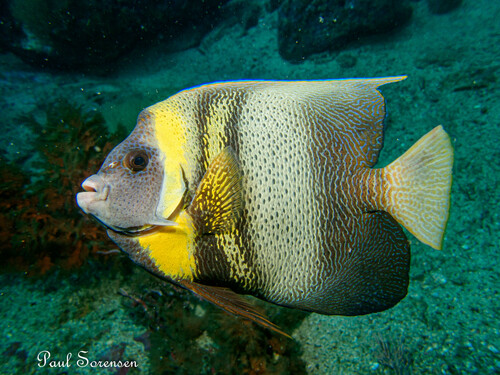
Pomacanthus zonipectus has a deep, compressed body, a short blunt snout, and a small mouth holding many small bristle-like teeth. A large spine sits at the corner of its preoperculum, which has a smooth vertical edge; the area under the eye and the operculum have no spines. This species can reach a maximum total length of around 46 centimetres (18 inches). Like other species in the genus Pomacanthus, juvenile and adult Pomacanthus zonipectus have very different appearances. Adults have crisscrossing lines covering the posterior half of their body, and this area becomes yellowish-green on the tail. They have a large yellow arc behind the pectoral fins, a bright yellow saddle across the nape, and a pale grey section in the middle of their flanks. Juveniles have a brownish-black base colour, crossed by 6 vivid vertical yellow bands that run from the face to the caudal peduncle, with parallel blue bars between the yellow bands. The dorsal and pelvic fins of juveniles have bright blue margins. Pomacanthus zonipectus has 11 spines and 24–25 soft rays in its dorsal fin, and 3 spines and 20–22 soft rays in its anal fin.
Pomacanthus zonipectus is distributed in the eastern Pacific Ocean, ranging from Puerto Peñasco in the northern Gulf of California, Mexico, south to Peru. It has been recorded as a vagrant in southern California, the Galapagos Islands, Cocos Island and Malpelo Island, and has not been reported from Clipperton Island.
This species occurs at depths between 6 and 50 metres (20 and 164 feet). It is diurnal, and feeds on items collected from the seabed: its main prey is sponges, but it also eats tunicates, algae, bryozoans, hydroids, and fish eggs. Adults form pairs that range widely over reefs, while solitary juveniles are territorial. Spawning occurs from midsummer to early autumn, and juveniles are most abundant between August and November. This species appears to be monogamous. Juveniles can also be found in tidal pools.