About Pomacanthus xanthometopon (Bleeker, 1853)
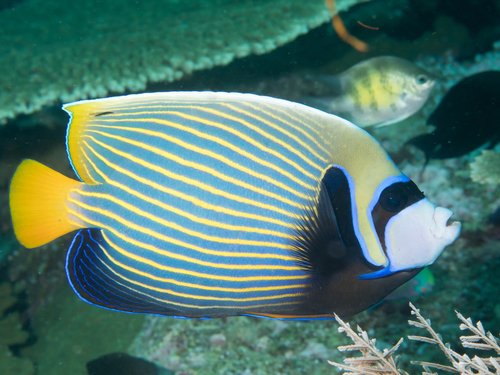
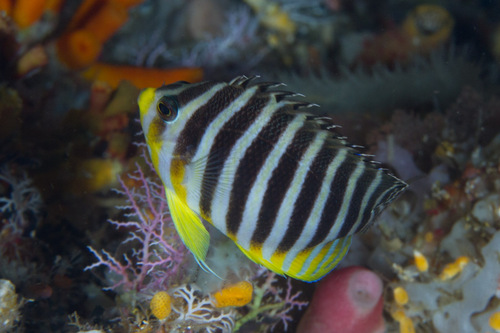
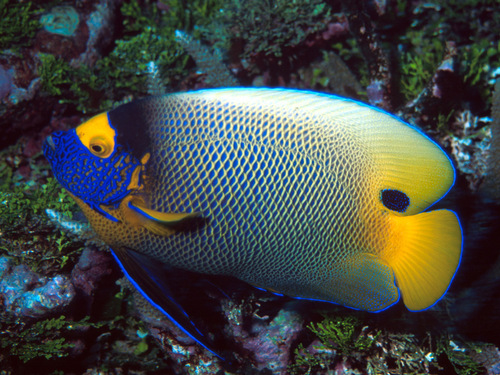
Pomacanthus xanthometopon reaches a maximum total length of 38 centimetres (15 in) and has a laterally compressed body. Its mouth sits just above the tip of the snout. Its large, rounded fins are yellow, with some fins edged in blue along their margins. The dorsal fin is located just in front of the caudal region, it bears a distinct black eyespot at its base, and has 13–14 spines plus 16–18 soft rays. The anal fin has 3 spines and 16–18 soft rays. Its scales are pale blue with yellow edges, creating an overall reticulated pattern. The face is yellow: the lower half has a dense network of bright blue lines, and a solid yellow mask of color surrounds the eyes. Juveniles have quite different coloration: they show 6 vertical white bars separated by pale blue lines, and their caudal fin has barring in two shades of blue. Juveniles gradually change to adult coloration once they reach between 7 and 12 centimetres (2.8 to 4.7 in) in length. This species can be mistaken for the queen angelfish (Holacanthus ciliaris) or the blue angelfish (Holacanthus bermudensis), but both of these species have fully blue faces and do not have a caudal eyespot. Pomacanthus xanthometopon inhabits coral reefs in the eastern tropical Indo-Pacific. Its confirmed range covers the Maldive Islands, Malaysia, Indonesia, Japan, Taiwan, the Philippines, northern Australia, and Micronesia. It has occasionally been sighted off the coast of Florida. It prefers lagoons, outer reef slopes, and channels at depths up to around 25 metres (82 ft), and is often found among rocks and near cave formations. Juveniles of this species frequently live inside caves.