About Pomacanthus sexstriatus (Cuvier, 1831)
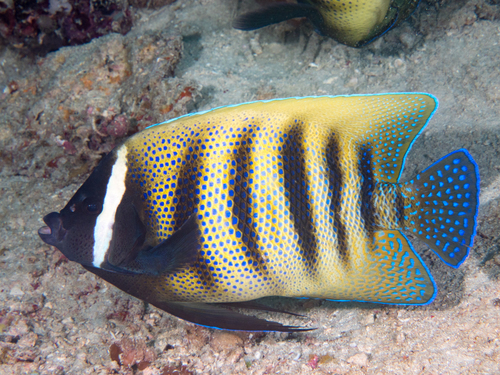
Pomacanthus sexstriatus, commonly called the sixbar angelfish, has distinctly different appearances between juvenile and adult individuals, like other members of the genus Pomacanthus. Juveniles have an overall blue-black body marked by many vertical white bands. The bands toward the front of the body are quite straight, while the posterior bands become more curved the closer they are to the tail. Adults have brownish-yellow base coloration across their body and median fins, covered in bright blue spots. There are 6 vertical bands along the flanks: the first band is whitish and located directly behind the head, and the 5 following bands are black. This species can reach a maximum total length of approximately 46 cm (18 in) in the wild. Sixbar angelfish have 13 to 14 spines and 18 to 23 soft rays in their dorsal fin, and 3 spines and 18 to 19 soft rays in their anal fin. The sixbar angelfish's distribution ranges from Sri Lanka through the Malay Archipelago to the Solomon Islands. Its range extends north to the Ryukyu Islands of southern Japan and Palau, and south to New Caledonia and Australia. In Australia, the species occurs from Shark Bay in Western Australia along the northern coast to the Capricorn and Bunker Group off Queensland. It is also found around the Rowley Shoals and Scott Reef of Western Australia, and at Ashmore Reef in the Timor Sea. Sixbar angelfish inhabit depths between 1 and 60 m (3 ft 3 in and 196 ft 10 in). They occur on coastal reefs, lagoon reefs, and outer reef slopes. Adults live either in pairs or as solitary individuals in areas with abundant coral growth, while juveniles prefer sheltered inner reef environments. When alarmed, this species produces loud grunting sounds. It is an omnivorous species that feeds on macroalgae, sponges, and tunicates.