About Pomacanthus semicirculatus (Cuvier, 1831)
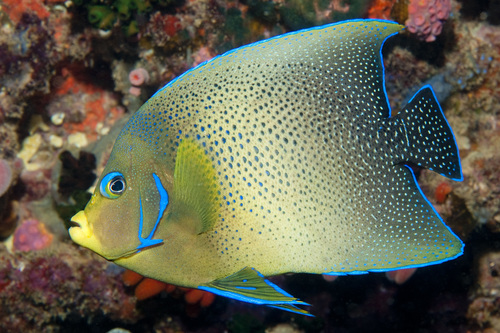
Pomacanthus semicirculatus, like other species in the genus Pomacanthus, shows stark differences in appearance between adults and juveniles. Adult individuals are brownish-green, with blue edges on each scale that create blue speckling across their body and tail. All fins except the plain yellow pectoral fins have blue margins, and long, filamentous growths extend from the dorsal and anal fins. In contrast, juvenile P. semicirculatus are blue-black, marked from top to bottom with narrow white stripes. These stripes are fairly straight near the head, and become increasingly curved closer to the base of the tail. Juveniles gradually transition to adult coloration once they reach between 8 and 16 centimetres (3.1 to 6.3 in) in length. The dorsal fin of this species has 13 spines and 20–23 soft rays, while the anal fin has 3 spines and 18–22 soft rays. The species reaches a maximum total length of 40 centimetres (16 in). P. semicirculatus is native to the Indo-Pacific region. Its range extends along the eastern coast of Africa, from the southern Red Sea coast of Sudan south to South Africa. From there, it occurs east across the Indian and Pacific Oceans as far as Fiji, Tonga, and Samoa. Its range extends north to southern Japan and south to Australia. Within Australia’s exclusive economic zone, this species is widespread from the Houtman Abrolhos in Western Australia, around the Australian coast to Sydney on the eastern coast; juveniles can be found even farther south at Merimbula. It is also found at Christmas Island, the Cocos (Keeling) Islands, and Lord Howe Island in the Tasman Sea. Sporadic sightings of the species have also been recorded off the east coast of Florida since 1999, and at Oahu, Hawaii since 2005. P. semicirculatus inhabits sheltered coral reefs at depths between 1 and 40 metres (3 ft 3 in to 131 ft 3 in), where it feeds on algae, tunicates, and sponges. Juveniles of this species are very timid and hard to approach. They occupy shallow, sheltered areas, while adults prefer coastal reefs with rich coral growth that provides plentiful hiding spots. This species is typically encountered either alone or in pairs, and adults have also been recorded living on shipwrecks.